The Chimney Cake Hunt: Chasing Kürtőskalács Across Budapest
A local's hunt for real kürtőskalács in Budapest, from the Transylvanian origin story to which bakeries roll the spiral fresh and what a proper one costs.
 By Gábor Kovács, Budapest local specialist and experience guide
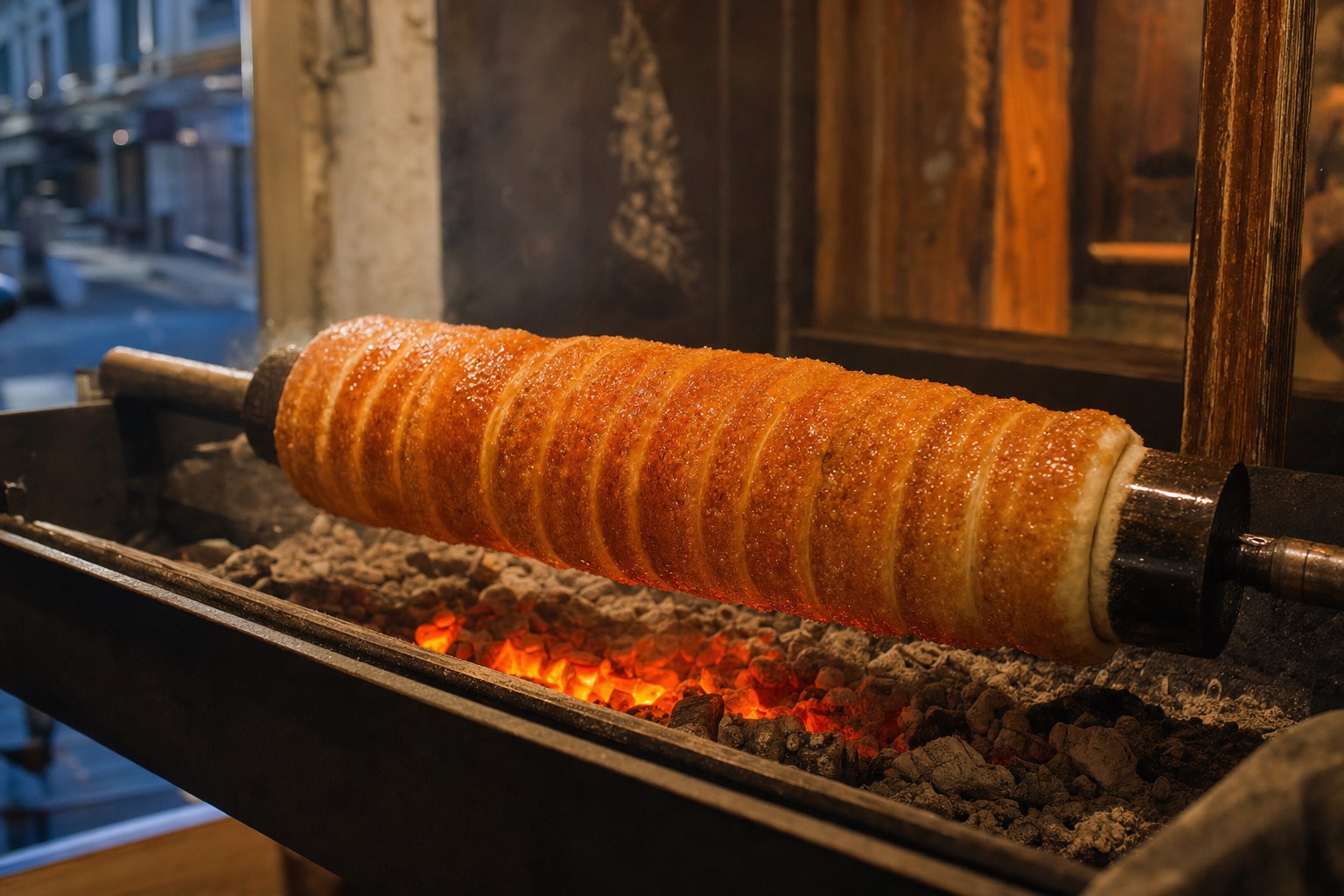
You smell it before you see it. Caramelizing sugar has a reach of about half a street, and in this city it works like a lure. Somewhere ahead, a cylinder of dough is turning over heat, and I will find it, because I have been finding them since I was a kid getting one as a bribe for behaving at the Christmas market. The kürtőskalács (chimney cake, a spit-roasted spiral of sweet dough) is everywhere in Budapest now. The problem is that most of them are bad. This is the story of hunting the good ones.
Use the bakery advice below to plan your own hunt. A dedicated workshop also lets you learn the craft behind a fresh chimney cake.
Booking choice: Shape, bake and season three chimney cakes, then take the recipe and your cakes home. Explore Downtown Chimney-Cake Workshop
What Is Kürtőskalács, Exactly?
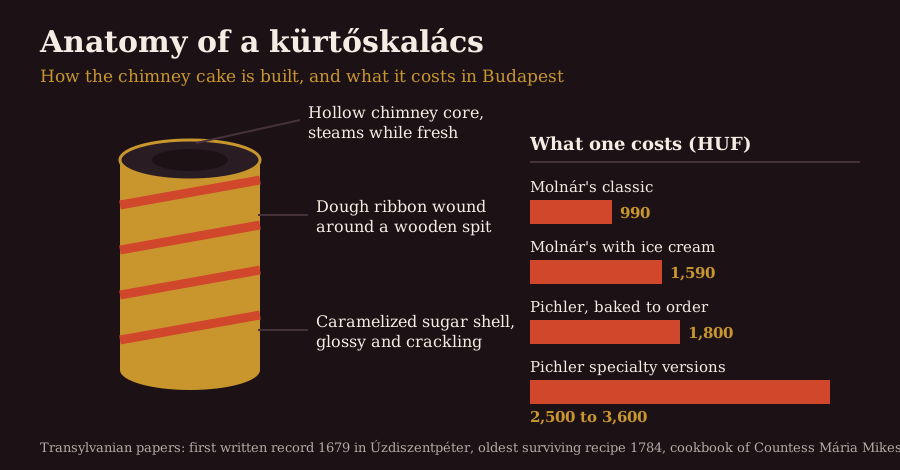
Kürtőskalács is a sweet yeast dough cut into a long ribbon, wound around a wooden spit, rolled in sugar, and roasted over heat while turning. The sugar caramelizes into a crisp shell around a soft, steamy spiral, and the finished cake slides off the spit as a hollow tube, the "chimney" of the name.
The name breaks down simply: kürtő is a stovepipe or chimney, kalács is a festive sweet bread. What you get is architecture you can eat. A crackling caramel outside, an interior that pulls apart along the spiral in warm ribbons, and a hollow core that steams when the cake is fresh.
That word, fresh, is the whole game. A kürtőskalács is glorious for about twenty minutes and merely fine after an hour. Everything in this piece flows from that fact.
Where Does Chimney Cake Actually Come From?
Transylvania, not Budapest. The first written record dates to 1679 in the village of Úzdiszentpéter, now Sânpetru de Câmpie in Romania, and the oldest surviving recipe appears in a 1784 Transylvanian cookbook by Countess Mária Mikes of Zabola. Budapest adopted the cake much later and turned it into street food.
Hungarians will happily let visitors believe the chimney cake is a Budapest native, but its papers say otherwise. It grew up in Székely Land, in Hungarian-speaking Transylvania, as a celebration bread for weddings and holidays. The documented history, laid out in the kürtőskalács record on Wikipedia, runs from that 1679 mention through the countess's 1784 recipe and on into the village-fair culture of the 19th century.
| Year | Milestone |
|---|---|
| 1679 | First written record, Úzdiszentpéter, Transylvania |
| 1784 | Oldest surviving recipe, cookbook of Countess Mária Mikes of Zabola |
| Today | Budapest bakeries roll it to order daily, some from 9:30 in the morning until 22:00 |
My grandmother would add a fourth row: whatever year her own mother first made one at home, rolled on a rolling pin over the stove because nobody owned a spit. Every Hungarian family with Transylvanian roots has a version of that row.
Where Do You Find The Good Ones In Budapest?
A handful of dedicated bakeries roll and roast to order rather than reheating. Molnár's on Váci utca is the classic old-guard address, Pichler near Kossuth Lajos utca bakes each cake fresh from 9:30 to 22:00 daily, and Édes Mackó by the Zoo covers vegan and gluten-free versions. All three are names worth crossing the city for.
The hunt has fixed coordinates, confirmed in The Fun Group's Budapest guide:
| Place | Where | Why go | Price signal |
|---|---|---|---|
| Molnár's Kürtőskalács | Váci utca 31 | The traditional downtown standard | 990 HUF classic, 1,590 HUF with ice cream |
| Pichler Chimney Cake and Gelato | Kossuth Lajos utca 4 | Baked to order, open 9:30 to 22:00 daily | 1,800 HUF traditional, 2,500 to 3,600 HUF specialty |
| Édes Mackó (Vitéz Kürtős) | Állatkerti körút 14 to 16, by the Zoo | Vegan and gluten-free versions, call ahead for same-day | Varies by version |
Three places, three philosophies. Molnár's is where you take someone for their first one, on the walking street, unfussy. Pichler is the modern craft take, where you wait while yours turns over the heat and the price buys you that wait. Édes Mackó is the answer to a question the old bakers never heard: my friend cannot eat gluten, can she still have one? Yes, with a phone call ahead.
How Do You Spot A Tourist-trap Chimney Cake?
Look at the spits. A good stand has cakes turning over heat right now and a short pause between your order and your cake. A bad one has a warming cabinet full of pre-baked tubes getting sad under a heat lamp. Pale color, no caramel crackle, and a cake that bends instead of cracking are the giveaways.
The chimney cake boom put a stand on every corner between the Basilica and the river, and plenty of them sell dough that was roasted hours ago. My field test takes five seconds. Is anything actually rotating? Does the surface look lacquered, deep amber, almost burnt at the ridges? When they hand it over, is it too hot to hold comfortably? Three yeses and you are safe.
| Sign | Fresh roaster | Reheat stand |
|---|---|---|
| Spits over heat | Turning while you watch | Empty, or decorative |
| Surface | Glossy caramel, dark ridges | Matte, evenly pale |
| First bite | Crackle, then steam | Chew, no steam |
| Wait time | A few minutes | Instant handover |
One caveat from a local: a queue means nothing. Tourists queue at reheat stands too. Watch the spits, not the people.
What Does A Proper Chimney Cake Cost Right Now?
Roughly 990 to 1,800 HUF for a classic, depending on where and how it is made. Molnár's sells the traditional cake at 990 HUF, while Pichler's baked-to-order version runs 1,800 HUF and its specialty creations reach 2,500 to 3,600 HUF. Anything far above that range is buying the location, not the cake.
Prices have climbed with everything else in town, but the spread tells you what you are paying for. At the bottom, a classic cinnamon-rolled cake from a high-volume bakery. In the middle, the to-order experience. At the top, the loaded versions: gelato stuffed into the hollow core, chocolate linings, cones built for photographs. I am not the police of anyone's dessert, but my own money goes to the plain cinnamon cake nine times out of ten. The spiral needs no passengers.
For context on how this fits the wider cost of eating here, my Budapest food prices guide puts these numbers next to everything else you will eat in a day.
Can You Taste One Without Doing The Hunt Yourself?
Yes. The Foodapest market-to-tavern walk folds chimney cake into a twelve-plus-tasting route that also covers goulash, lángos and Hungarian wines, so the finding is done for you. Guests rate the walk 4.9 across 581 GetYourGuide reviews, and the guide handles the fresh-versus-reheated judgment call.
And if you want to go one level deeper than eating, Kató Néni Finomságai at Október 6. utca 6 runs kürtőskalács baking workshops of 45 to 60 minutes, several sessions a day, all year. You roll your own ribbon, wind your own spit, and learn exactly why the professionals make it look easy.
Which Flavor Should You Order First?
Cinnamon. It is the reference version, the one the caramel was designed to meet, and the one every serious baker judges themselves on. After that, walnut is the traditionalist's second, and the coconut, cocoa and vanilla coatings are all fair play. Save the stuffed and iced versions for your second or third cake.
Order the cinnamon, take it somewhere you can sit, and do the thing every Hungarian does without thinking: unwind it. The cake wants to be pulled apart along its spiral, one warm ribbon at a time, not bitten like a sandwich. Eat it within twenty minutes. Let the steam out of the chimney.
The hunt pairs naturally with the rest of a street-eating day. Start with a morning at the market, the quiet version I described in my dawn walkthrough of the Great Market Hall, then work through the savory canon in my street food guide before you let the sugar smell pull you in. By evening you will understand why half the city walks around holding a warm tube of bread, grinning.
Choose Your Budapest Experience
Downtown Chimney-Cake Workshop. Shape, bake and season three chimney cakes, then take the recipe and your cakes home. Have a date in mind? Check it before arranging the rest of your Budapest day.
60 minutes. Age 7+. Meet inside Kató Néni Finomságai, Október 6. utca 6. Basement workshop; not wheelchair accessible. Vegan dough; confirm toppings and any allergies.
Choose a date to see scheduled departures. Final availability and price are confirmed on Viator.
No verified experience fits those requirements. Adjust your choices, or keep the independent plan described above.
Compare Options And Fit Your Plans
General recommendations until you choose. Sightseeing cruises use recorded commentary; the dinner cruise has no guide. All selected activities meet in central Pest; use the operator confirmation for the exact point and option.
- Foodapest Market To Tavern: 180 minutes. Traditional dishes, street-food tasters and wines with an English-speaking local guide. Daytime option visits the market; the 17:00 option skips it. Notify the operator about vegetarian or vegan substitutions. Not suitable for coeliac requirements.
- Private Coffee And Cake Walk: 150 minutes. Discover Budapest’s grand cafés, neighbourhood confectioneries and strudel shops with a private local guide. Confirm the pickup point with the operator. Coffee and dessert stops form the experience; dietary suitability and specific cafés need confirmation.