Great Market Hall Budapest 2026: Hours, Floor by Floor, What to Buy
Budapest's biggest covered market has fed the city since 1897. Here is how to work it like a local, floor by floor, without paying the tourist premium.
 Written with Gábor Kovács, Budapest local specialist and experience guide
Short answer
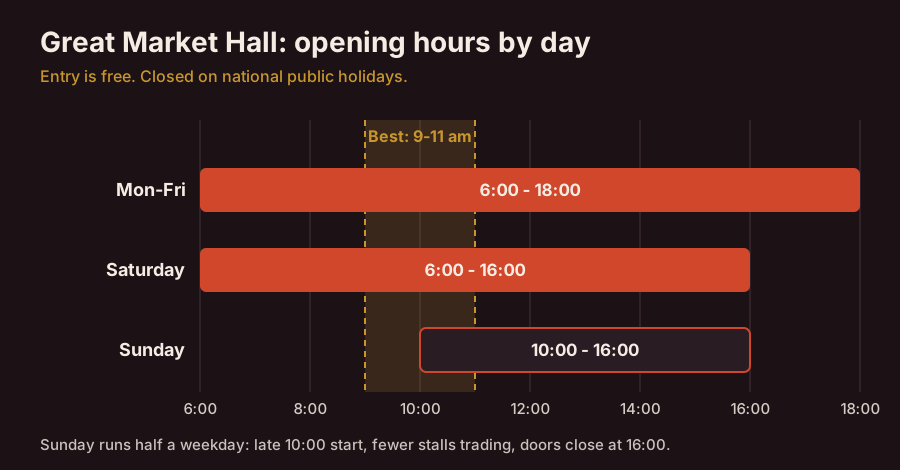
The Great Market Hall (Nagy Vásárcsarnok) is Budapest's largest covered market, open since 1897 at the Pest foot of Liberty Bridge. Entry is free. Hours are 06:00-18:00 Monday to Friday, 06:00-16:00 Saturday and 10:00-16:00 Sunday, closed on national holidays. Go between 9 and 11 am, when stalls are stocked and the crowds are still thin.
My grandmother bought her paprika from the same stall in this hall for thirty years, and the vendor's daughter still recognizes our family. That is the thing about the Great Market Hall that photos never catch. Under the famous Zsolnay-tiled roof it is part tourist attraction, part working market, and the trick to enjoying it is knowing which parts are which. I shop here most weeks. Let me walk you through it the way I would walk a friend through it.
Entry and independent browsing remain free. Foodapest’s daytime walk adds a local guide and tastings beyond the hall; its evening option does not visit the market.
Booking choice: Foodapest combines traditional dishes, street-food tasters and wines in a three-hour guided walk. Explore Foodapest Market To Tavern
What Is The Great Market Hall?
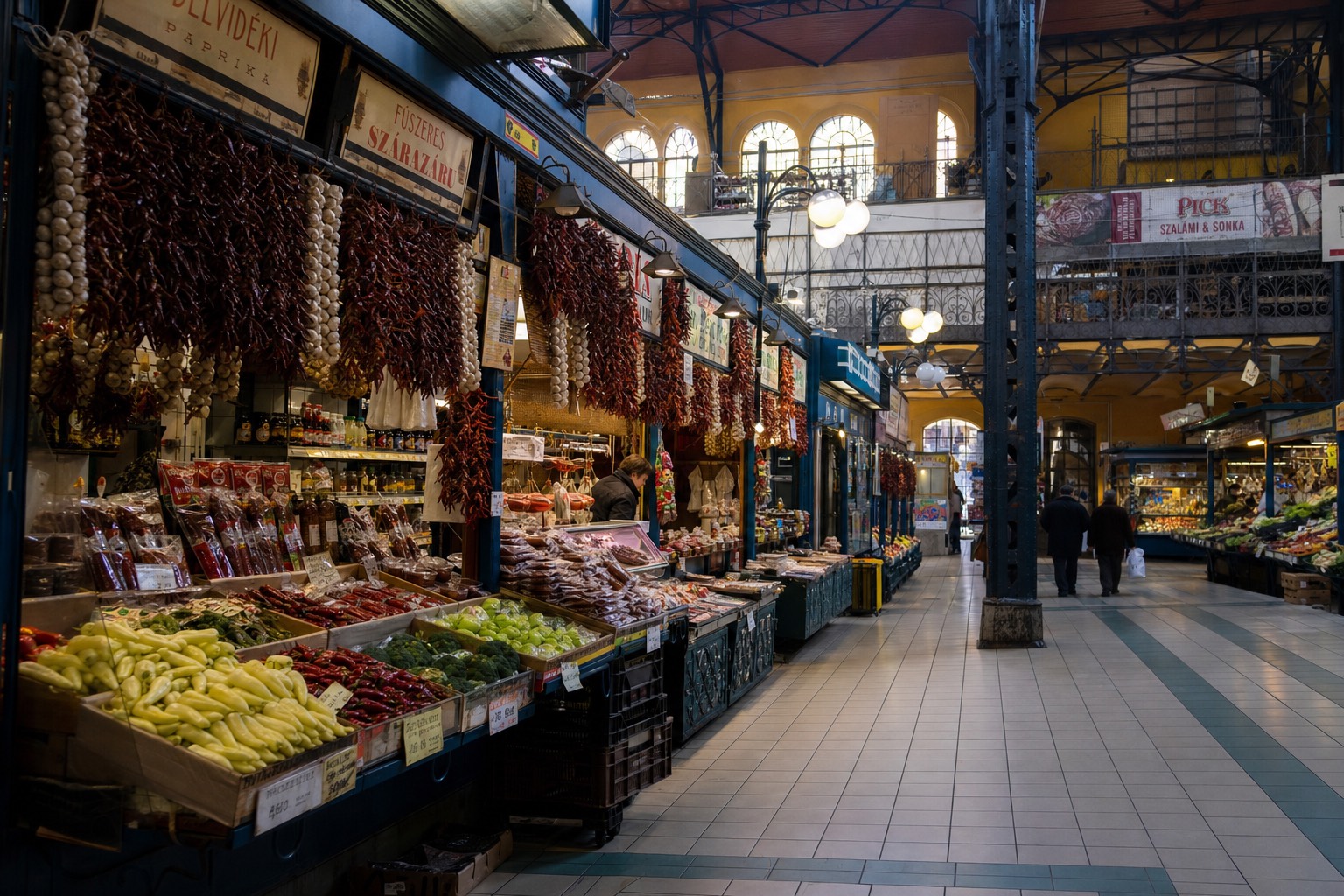
The Great Market Hall, Nagy Vásárcsarnok (literally "great market hall"), is Budapest's largest and oldest covered market. It opened in 1897 at Fővám tér, the Pest end of Liberty Bridge, and still operates as a real food market across three floors: produce and meats on the ground floor, food stalls and folk craft upstairs, fish and pickles below.
The building itself is worth the walk even if you bought nothing. Architect Samu Pecz designed it as a cathedral for food, all steel ribs and glass, with a roof of glazed Zsolnay ceramic tiles that glows orange and green in the sun. When it opened in 1897, goods arrived by barge through a canal that connected the basement to the Danube. The canal is long gone. The wholesale energy is not, especially early in the morning when restaurant buyers move through with trolleys.
You will hear three names used for the same building: Great Market Hall, Central Market Hall and Nagy Vásárcsarnok. Locals mostly say "a Vásárcsarnok". If a taxi driver looks blank, say Fővám tér.
What Are The Great Market Hall's Opening Hours?
The hall opens 06:00 to 18:00 Monday through Friday, 06:00 to 16:00 on Saturday, and 10:00 to 16:00 on Sunday. It closes on national public holidays. Sunday is the odd one out: a late start, a short day, and fewer stalls trading, so build Sunday plans around the 10:00 opening.
| Day | Hours | What to expect |
|---|---|---|
| Monday | 06:00-18:00 | Quietest weekday, a few stalls restocking after the weekend |
| Tuesday-Friday | 06:00-18:00 | Full trading, best overall days |
| Saturday | 06:00-16:00 | Busiest day, locals doing the week's shop plus tour groups |
| Sunday | 10:00-16:00 | Late start, short day, reduced stall lineup |
| National holidays | Closed | Check before you go on Hungarian public holidays |
Those hours come from the current listings kept by Budapest By Locals, and they match what I see on the doors. The Sunday pattern deserves a second mention because it catches people out: for years the hall kept Sundays completely dark, and even now the Sunday session is a shorter, sleepier affair. If the market is the anchor of your day, aim for a weekday.
Seasonal events shift things too. The ground floor hosts a three-week Easter and Spring Fair from March 14 to April 7 in 2026, with special hours and full closures on Good Friday and Easter Sunday and Monday.
Is Entry To The Great Market Hall Free?
Yes. Walking into the Great Market Hall costs nothing, today and every day. There is no ticket, no queue to pay, no "market entry fee" of any kind. Anyone selling you a ticket for entry alone is selling you something you do not need. You pay only for what you eat, drink or carry out.
This matters because the hall sits on every "free things to do in Budapest" list, and it earns the spot. You can spend an hour under that roof, photograph the paprika garlands, ride the escalator up for the view down the nave, and leave without opening your wallet. Guided tours that include the market charge for the guiding and the tastings, not the door.
One honest caveat: free entry means the ground floor gets packed. Which brings us to timing.
What Is The Best Time To Visit The Central Market Hall?
Between 9:00 and 11:00 in the morning. Vendors are fully stocked, locals are shopping for produce, and the crowds are noticeably lighter than at lunchtime or late Saturday morning. Come at 6:00 on a weekday if you want the market at its most real, but 9 to 11 is the sweet spot for a visitor.
That 9-to-11 window is the standing advice from the market-focused guides at Budapest Cooking Class, and my own shopping habit agrees with it. Before 9 the hall belongs to trolleys and wholesale orders, which is atmospheric but brisk. After 11:30 the upstairs food stalls develop queues, and by 13:00 on a summer Saturday the main aisle moves at shuffle speed.
If mornings are your thing, my note on a morning spent inside the hall walks through what the first two hours actually look and smell like.
What Can You Eat There, Floor By Floor?
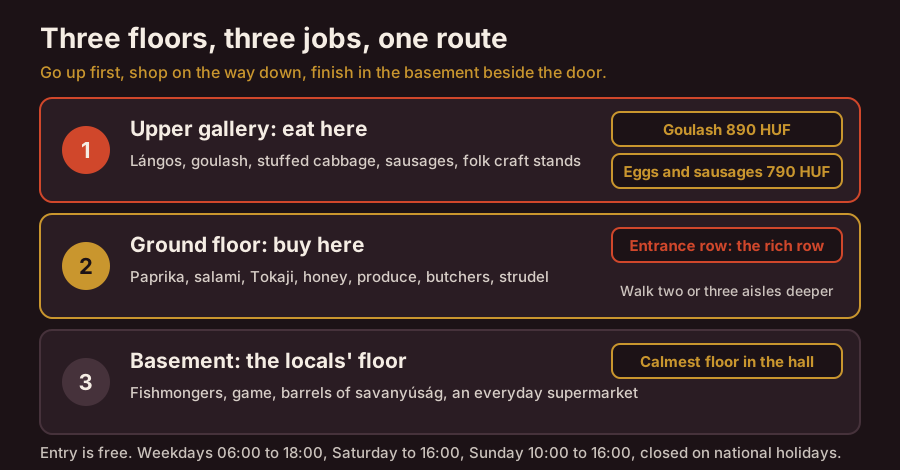
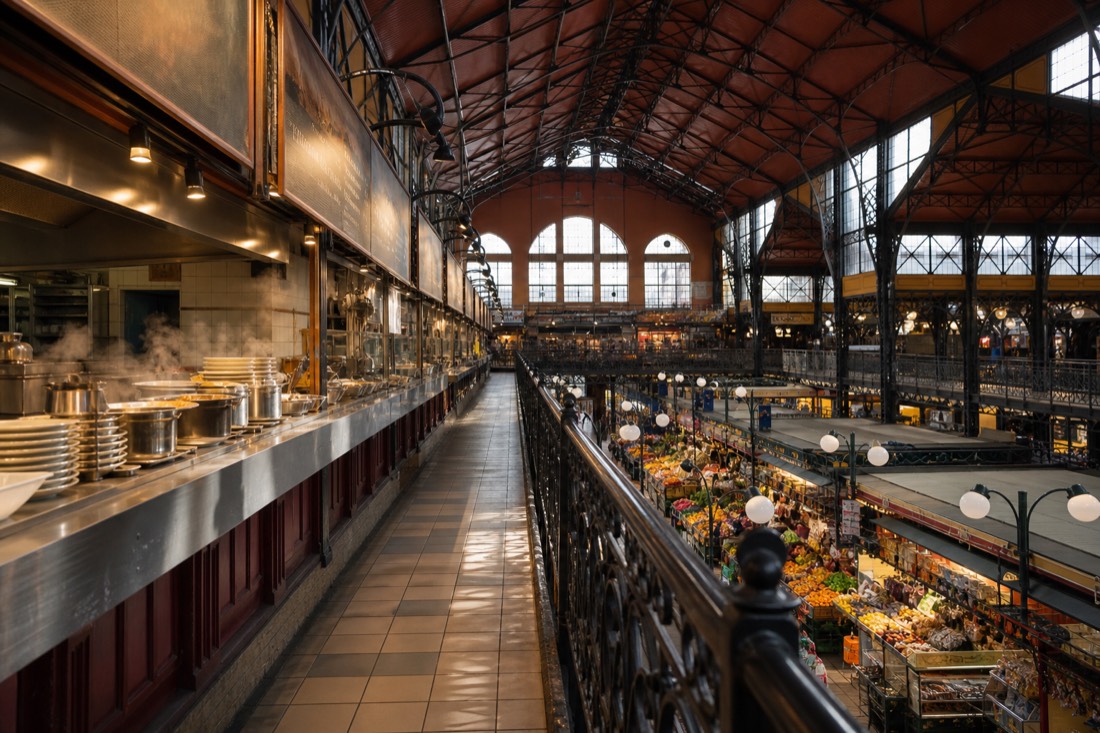
Three floors, three jobs. The ground floor is raw ingredients: produce, meats, paprika, honey. The upper gallery is where you eat: lángos (deep-fried flatbread) stands, stuffed cabbage, goulash by the bowl. The basement handles fish, game and pickles, plus an ordinary supermarket locals actually use.
| Floor | What's there | Eat or buy? |
|---|---|---|
| Upper gallery | Hot food stalls (lángos, goulash, stuffed cabbage, sausages), folk craft and embroidery stands | Eat here |
| Ground floor | Fruit and vegetables, butchers, paprika and spice stalls, salami counters, Tokaji and pálinka shelves, honey and strudel | Buy here |
| Basement | Fishmongers, game, barrels of savanyúság (Hungarian pickled vegetables), an everyday supermarket | Locals' level |
The upstairs stalls are the cheapest sit-down-ish hot Hungarian food in the city center. Fakanál, the best known of them, lists scrambled eggs with sausages at 790 HUF and goulash or fishermen's soup at 890 HUF, which undercuts every restaurant within a kilometer. The catch is seating: elbow room at a stand-up counter if you are lucky. Order the lángos with sour cream and cheese, eat it hot, and accept that your hands will smell of garlic until evening.
For how market lángos compares with the rest of the city's street food, the street food guide ranks the options, and the wider food price guide puts these numbers next to restaurant menus.
What Should You Buy: Paprika, Salami And Tokaji?
The classic take-home trio is ground paprika, dry salami and a bottle of Tokaji dessert wine, and the hall sells serious versions of all three. Skip the stalls nearest the main entrance, walk two or three aisles deeper, and compare a couple of vendors before you commit.
| Item | What to look for | Where in the hall |
|---|---|---|
| Paprika | Tins or linen sacks marked édesnemes (noble sweet) or csípős (hot); Kalocsa and Szeged are the origin names that matter | Ground floor spice stalls, past the entrance row |
| Salami | Whole dry sticks travel best; vacuum-sealing on request | Ground floor butcher counters |
| Tokaji | Aszú is the famous sweet style; late-harvest bottles are the budget cousin | Ground floor wine shelves |
| Savanyúság | Pickled peppers, sauerkraut, whole pickled garlic, sold from open barrels | Basement |
| Honey and strudel | Acacia honey keeps for months; strudel does not survive the flight, eat it same day | Ground floor |
Here is the local knowledge that saves you money: the paprika section right by the main entrance is nicknamed the rich row, because its prices sit above what the very same products cost a few aisles in. Nothing dishonest about it, prime position costs the vendor more. Just know that the hall rewards a five-minute walk before you buy. I go deeper into picking tins, grades and fakes in the paprika shopping notes.
How Do Food Tours Use The Market?
Most serious Budapest food walks either start or finish in the Great Market Hall, using the stalls as a live classroom: taste paprika grades side by side, try lángos from the vendor the guide trusts, then leave the tourist floor behind for taverns locals eat in. You get the hall decoded, not just photographed.
If you would rather graze solo, pair this guide with the rundown of what to eat in Budapest and build your own tasting run: lángos upstairs, strudel from the ground floor, pickles from the basement.
Is The Great Market Hall A Tourist Trap?
Partly, and pretending otherwise would be silly. The ground-floor aisles nearest the door charge entrance-row prices, the upstairs souvenir stands sell the same magnets as Váci utca, and midday summer crowds are real. But underneath that layer sits a genuine working market where locals still shop daily. Both things are true.
My honest scorecard: the produce, butcher and spice stalls are real, and their customers are Hungarian grandmothers with opinions. The basement barely sees tourists at all. The upper gallery is the most touristy zone, yet even there the food is honest and cheap by center-of-Budapest standards; 890 HUF goulash is not a trap by any definition. What I would skip: buying paprika at the first stall you see, and the embroidered tablecloth stands unless you have compared prices elsewhere.
Go in the morning, spend forint where the locals queue, and the hall gives you the best free sightseeing-plus-lunch combination in the city.
How Do You Work The Three Floors Without Backtracking?
Go up first, then work your way down. Ride the escalator to the gallery before the food queues form, eat while the stands are calm, shop the ground floor on the way back toward the door, and finish in the basement, which sits under the main entrance. That order means you carry the heavy jars for ten minutes instead of an hour.
Most visitors do the exact opposite. They stop at the first paprika display inside the door, photograph the garlands, drift along the central aisle with everyone else, discover the food upstairs at the same moment as every other visitor, then walk the whole building again to buy what they saw on the way in. The hall punishes that pattern twice over. Its central aisle is the one real pinch point in the market, and the stalls closest to the entrance are also the ones charging entrance-row prices, so lingering there costs you time and forint at once.
The bottleneck logic is easy once you see it. Two flows share the building: shoppers on the ground floor and eaters on the gallery, and they collide on the stairs and escalator around midday. Get above the crush early and the rest of the visit runs downhill in both senses. With a wheeled bag or a stroller, the escalator is the practical way up and the stairs by the entrance are the quickest way back down.
| Step | Where you are | Allow about | Why this slot |
|---|---|---|---|
| 1 | Straight down the central aisle, no stopping | 5 minutes | Clears the entrance crush and the priciest stalls in one pass |
| 2 | Upper gallery, hot food | 25-30 minutes | The stands move fastest before 11:30 |
| 3 | Upper gallery, craft and embroidery loop | 10 minutes | Browse now, decide later, prices differ stand to stand |
| 4 | Ground floor: paprika, salami, wine, honey | 25 minutes | Buy the heavy things last, two or three aisles in |
| 5 | Basement: pickles, fish, supermarket | 10 minutes | Nearest the exit and the calmest floor in the building |
Read those as planning allowances, not a timetable. Some people spend forty minutes upstairs because they found a counter seat and a second bowl; others skip the craft loop entirely. The sequence is what matters, and it holds on any day the hall is open.
What Does A Local Buy Here, And What Is Priced For Visitors?
Buy the food, hesitate over the souvenirs. Paprika, salami, honey, wine and basement pickles sell at genuine market prices once you are past the entrance row. The craft stands upstairs and anything within a few steps of the main door are priced for shoppers who will not compare, and comparing costs you five minutes.
I have been showing international visitors around this city since 2022, and by my own rough count more than a thousand people have walked through these doors with me. The pattern almost never changes: everyone wants to buy paprika, nobody wants to walk past the first stall selling it. So here is my working list, honestly labelled. It is a shopper's judgment, not a tour operator's.
| What you are looking at | Worth it? | What I do |
|---|---|---|
| Entrance-row paprika tins | Priced for the position | Walk two or three aisles deeper for the same grades |
| Deeper-aisle paprika, tins or linen sacks | Yes | Look for édesnemes or csípős and a Szeged or Kalocsa origin |
| Goulash or fishermen's soup upstairs at 890 HUF | Yes | The cheapest hot Hungarian bowl I know of in the center |
| Scrambled eggs with sausages at 790 HUF | Yes, if you come early | The best-value hot breakfast inside the tourist zone |
| Whole dry salami sticks | Yes | Ask for vacuum sealing if you are flying home |
| Embroidery and tablecloths upstairs | Only after comparing | The same designs turn up on Váci utca at other prices |
| Printed souvenirs and magnets | Skip | Nothing here you cannot find cheaper on the way to your hotel |
| Barrel savanyúság in the basement | Yes | Sold by weight, so buy what you will actually eat this week |
| Strudel from the ground floor | Yes, same day | It does not survive a flight, and it barely survives an afternoon |
Two habits worth stealing. Buy honey rather than pastry if you want something that lasts, since acacia honey travels for months and nothing baked does. And carry a few thousand forint in cash: card acceptance is normal at the established stalls, but the barrels and the smallest vendors still prefer notes, which is also true across the city's markets. If restaurant billing customs are new to you, the service charge and tipping guide explains what lands on a Hungarian bill.
How Does The Hall Change Hour By Hour?
One building, four different markets in a day. Six to eight belongs to trolleys and restaurant buyers. Nine to eleven is the visitor sweet spot. From about 11:30 the food gallery grows queues, and the last stretch before closing is calm but picked over. Saturday compresses the whole cycle into ten hours instead of twelve.
The early shift is the one almost nobody sees, and it is the reason the building still feels like a market rather than an exhibit. Deliveries land, crates get stacked, and the aisles carry professional buyers moving with purpose. It is not a browsing atmosphere. Come at six because you want to watch a working morning, not because you want to shop slowly.
By nine the rhythm softens. Produce sellers have their displays finished, the butchers are cutting to order, and the neighborhood shoppers are the ones asking questions. That is the window the market guides recommend, and it is when I do my own shopping. After 11:30 the gallery queues start, and on a summer Saturday the central aisle moves at the pace of the slowest person in it.
| Time | Who is in the hall | Best for |
|---|---|---|
| 06:00-08:00 | Restaurant buyers, trolleys, early locals | Seeing a working market, photography with room to stand |
| 08:00-09:00 | Neighborhood shoppers arriving | Produce at its freshest, still no queues |
| 09:00-11:00 | The visitor window | Everything at once: stocked stalls, thin crowds |
| 11:00-13:00 | Everyone, all at the same time | Little, honestly; gallery queues build from about 11:30 |
| 13:00-15:00 | Peak drift, shuffle pace on summer Saturdays | Sitting down, if you can claim a counter spot |
| 15:00-16:00 | Saturday and Sunday wind-down | Short, targeted shopping before the doors close |
| 16:00-18:00 | Weekdays only, thinning out | A calm second pass, though not every stall stays open to the last minute |
What If You Arrive On A Sunday Or A Public Holiday?
Sunday runs 10:00 to 16:00 with a reduced stall lineup, so treat it as a half day and arrive at opening. National public holidays close the hall completely. Around Easter 2026 the ground floor also hosts a three-week fair from March 14 to April 7 with special hours, plus full closures on Good Friday and Easter Sunday and Monday.
The Sunday problem is not that the market is bad, it is that the market is short. Doors open four hours later than a weekday and shut two hours earlier, which leaves a six-hour window that overlaps precisely with when every other visitor has free time. If Sunday is your only option, be at Fővám tér for ten, do the gallery first as usual, and accept that some ground-floor vendors will not have bothered to open.
Holidays are stricter. A national holiday means closed, not "reduced", so check the Hungarian calendar before you build a day around the building. The Easter and Spring Fair is the interesting edge case: for three weeks the ground floor turns over to fair stalls, which is lovely to walk through and mildly annoying if you came with a shopping list, because the aisles you researched are rearranged.
When the doors are shut, the city still feeds you. Street windows and market-adjacent stands keep working through Sundays and holidays, and the street food guide maps them. If the hall was meant to be the spine of your trip, the three-day eating itinerary shows how to slide it to another morning without losing the rest of the plan.
What Does A 90-minute Visit Actually Look Like?
Arrive at 9:15, go straight up, eat by 9:30, browse the craft loop, come down for paprika and salami around 10:15, drop into the basement for pickles at 10:45, and be back outside before 11:00 with lunch eaten and gifts bought. Ninety minutes covers the whole building comfortably if you do not backtrack.
Here is how it plays out in practice. You come in from Fővám tér, resist the paprika wall by the door, and walk the length of the ground floor to the far escalator. Upstairs it is still quiet at 9:20, so you take a bowl of goulash at 890 HUF, or scrambled eggs with sausages at 790 if you skipped breakfast, and eat standing at a counter while looking down the nave at the roof ribs. That view alone is worth the climb.
By 9:45 you have circled the craft stands, noted two embroidered pieces without buying either, and taken the stairs down. Now the shopping. Two aisles past the entrance row you compare three paprika vendors, pick a tin of édesnemes and a small csípős, add a salami stick with a vacuum seal, and let the wine shelf tempt you into one bottle of late-harvest Tokaji rather than an Aszú you have not tasted. That is roughly twenty-five minutes, most of it spent comparing rather than deciding.
The basement is the coda. Pickled peppers by weight from a barrel, a look at the fish counter, a glance at the supermarket where actual residents are buying actual groceries, and out. The whole loop leaves you at Liberty Bridge before the lunch crowd arrives, carrying food you chose instead of food that was aimed at you. If you want the same route with a guide explaining the paprika grades as you taste them, that is exactly what a market-first walk is for, and the dos and don'ts guide covers the etiquette side of shopping and eating here.
Is the Great Market Hall open on Sunday?
Yes, but only 10:00 to 16:00, and with fewer stalls trading than on other days. It also closes fully on Hungarian national holidays, so check the calendar before planning a Sunday or holiday visit.How long do you need at the Great Market Hall?
One hour covers a relaxed loop of all three floors with a lángos stop. Add thirty minutes if you plan to actually shop for paprika, salami or Tokaji, since comparing a few vendors is where the savings hide.Can you pay by card at the market?
Most established stalls take cards, but smaller vendors and basement pickle barrels can be cash-first. Carry some forint; a few thousand HUF covers a generous grazing session upstairs.Is the Great Market Hall worth visiting?
Yes. Entry is free, the 1897 building is one of Budapest's finest interiors, and the upstairs stalls serve some of the cheapest hot Hungarian food in the center. Visit between 9 and 11 am to see it working rather than performing.Choose Your Budapest Experience
Foodapest Market To Tavern. Traditional dishes, street-food tasters and wines with an English-speaking local guide. Have a date in mind? Check it before arranging the rest of your Budapest day.
180 minutes. Daytime option visits the market; the 17:00 option skips it. Notify the operator about vegetarian or vegan substitutions. Not suitable for coeliac requirements.
Choose a date to see scheduled departures. Final availability and price are confirmed on Viator.
No verified experience fits those requirements. Adjust your choices, or keep the independent plan described above.
Compare Options And Fit Your Plans
General recommendations until you choose. Sightseeing cruises use recorded commentary; the dinner cruise has no guide. All selected activities meet in central Pest; use the operator confirmation for the exact point and option.
- Hungarian Cooking In A Local Home: 240 minutes. Prepare a Hungarian main course and dessert with a local chef; ingredients, equipment and a recipe booklet are included. Select the morning market option for the market visit; the evening option starts at the apartment. The operator cannot accommodate coeliac disease.
- Budapest Culinary And Wine Walk: 300 minutes. Explore food markets and neighbourhoods with an English-speaking food specialist, tasting Hungarian dishes and wines along the way. Allow five hours and substantial walking. Current option is private; private transport and gratuities are excluded. Dietary arrangements require confirmation.
- Private Coffee And Cake Walk: 150 minutes. Discover Budapest’s grand cafés, neighbourhood confectioneries and strudel shops with a private local guide. Confirm the pickup point with the operator. Coffee and dessert stops form the experience; dietary suitability and specific cafés need confirmation.