Goulash in Hungary: A Soup, Not a Stew, and How to Eat It Right
Almost everything the rest of the world believes about Hungary's national dish is wrong, starting with the idea that it is a stew.
 Written with Gábor Kovács, Budapest local specialist and experience guide
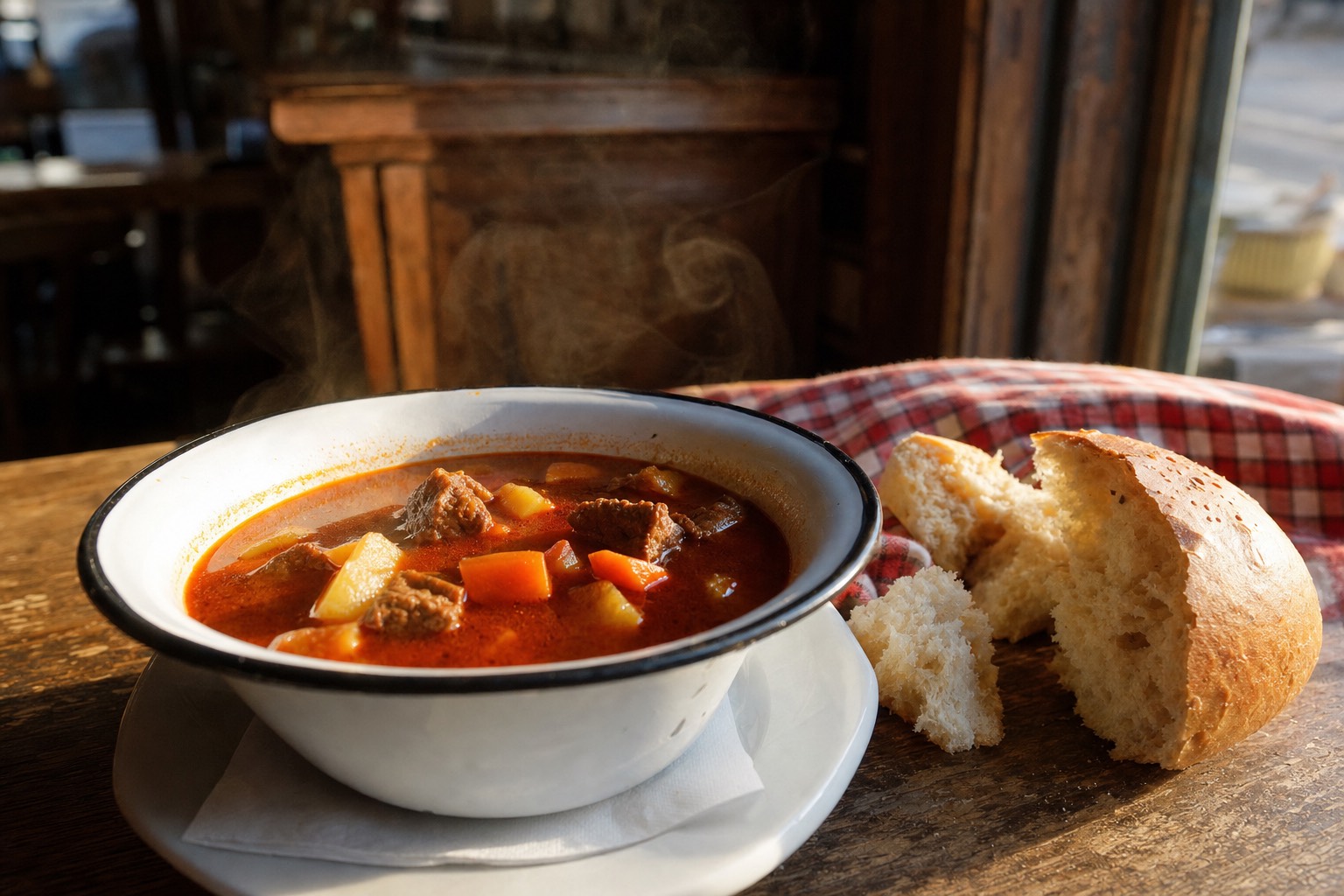
Short answer
In Hungary, gulyás is a paprika-spiced beef soup with potato and carrot, eaten with bread as a full meal. The thick dish the rest of the world calls goulash is closer to pörkölt, a separate stew. A bowl in a Budapest restaurant currently runs about €6 to €10.
My grandmother never once measured the paprika. She tipped it from a battered tin into a pot of slowly melting onions, always off the flame, and the kitchen in Zugló would turn that deep brick red that still means Sunday to me. So when a visitor on Váci utca asks me where to find "the famous Hungarian goulash stew," I have to break some news gently. There is no stew. There never was, not here. What Hungary actually eats under that name is better, lighter, and far older than the dish you are picturing, and once you know the difference you will order like someone who belongs at the table.
Use the dish guide below to recognise and order gulyás. A hands-on class is the next step if you want to learn to cook it.
Booking choice: Make goulash soup, a paprika main and apple strudel in a hands-on three-course cooking class. Explore Goulash Cooking At Chefparade
What Is The Most Famous Hungarian Dish?
Gulyás, the paprika beef soup the world knows as goulash, is Hungary's most famous dish and its unofficial national one. Ask any Hungarian and the answer comes back without a pause. Chicken paprikás, lángos, and kürtőskalács all trail behind it, but gulyás is the dish the whole country claims as identity.
It earns the title honestly. Gulyás appears at village cook-offs, wedding feasts, political rallies, and roadside csárda (country inn) menus alike, and every family guards its own version. Mine goes heavy on caraway. My neighbor swears by a whole tomato dropped in at the end, which my mother considers a crime she is still not over.
The dish also anchors the wider paprika canon that defines the cuisine here, a family of dishes I walk through in my guide to Hungarian food beyond goulash. If you only learn one Hungarian food word before your trip, make it this one. Just learn what it actually means first, because the international version of the story took a wrong turn somewhere over the Atlantic, and the next few sections untangle it.
Is Goulash A Soup Or A Stew In Hungary?
A soup, always. In Hungary gulyás means gulyásleves, literally goulash soup: beef, onion, and paprika in a generous red broth with potato and carrot, eaten with bread as a main course. Hungarian usage keeps a strict line between soups and stews, and gulyás sits firmly on the soup side.
This is not pedantry, it is the whole point. Hungarian meals are built around soup. Lunch traditionally opens with one, and gulyás is the rare soup hearty enough to be the entire meal. The broth should be loose enough to need a spoon and bread, never thick enough to hold a fork upright. In present-day Hungary the linguistic line is firm: gulyás is known as a soup, never a thickened stew, a distinction documented in detail in the Wikipedia entry on goulash, which is unusually good on the Hungarian-versus-export confusion.
When a Budapest menu offers "goulash stew" in English, one of two things is happening. Either the kitchen is translating pörkölt, the actual Hungarian stew, for foreign guests, or the restaurant is cooking for tourists rather than locals. Neither is a scandal, but it helps to know which pot you are ordering from. If the waiter brings a bowl of red soup with floating csipetke (pinched noodles), you are in the right place.
Where Does Goulash Come From?
From the cattle herdsmen of the Hungarian plain. The word gulyás means cattle herder or cowboy, from gulya, a herd of cattle. The dish's trail runs back as far as the 10th century, when herders cooked and flavoured meat, sun-dried it, and carried it in bags made from sheep's stomachs.
That portable dried meat could be revived on the open plain with water and whatever the fire allowed, which is why the dish's soul still lives in a bogrács, the cast-iron kettle hung over open flame. Paprika only entered the pot centuries later, after the spice arrived under Ottoman influence and Hungarian growers around Szeged and Kalocsa turned it into the national seasoning.
The herdsman origin explains the dish's character better than any recipe. It was food for men who owned a knife, a kettle, and a herd, so it forgives cheap cuts, rewards patience, and needs nothing you cannot carry. When Hungarians cook bográcsgulyás outdoors today, at a lake house or a village festival, they are not being rustic for show. They are cooking the dish the way it was born, and most will tell you, with total conviction, that it simply tastes better under open sky.
What Are The Four Ingredients In Goulash?
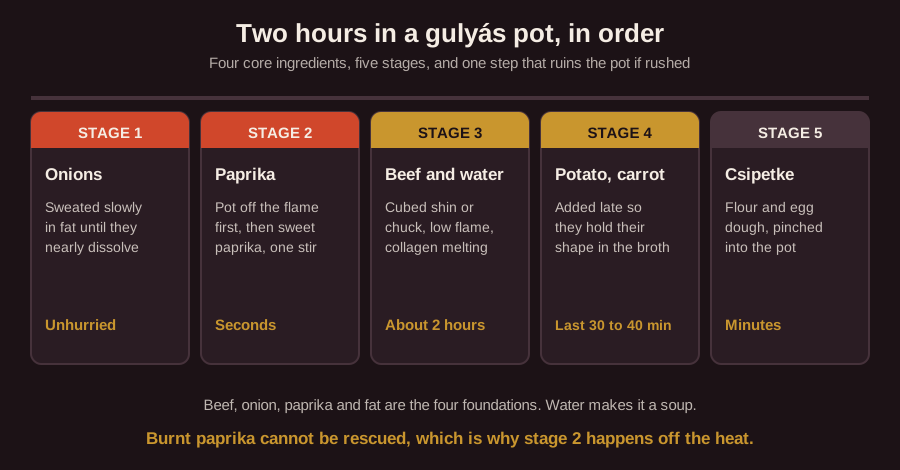
Beef, onions, Hungarian paprika, and fat, traditionally lard: those four build every real gulyás. Water turns the base into soup, and nearly every family pot adds potato, carrot, garlic, and caraway, plus csipetke. Take away any of the four foundations, though, and the dish stops being gulyás.
Each of the four does a specific job, and the proportions matter more than any exotic addition.
| Ingredient | What it does | The local standard |
|---|---|---|
| Beef shin or chuck | Collagen melts into body and silk | Cubed small, never ground |
| Onion | The sweet base of the whole dish | Nearly as much as the meat, chopped fine |
| Paprika | Colour, aroma, gentle heat | Sweet Hungarian édesnemes, added off the heat |
| Fat (lard) | Carries the paprika's flavour | Sunflower oil works, lard tastes like home |
| Potato and carrot | Turn the base into a full meal | Added in the last 30 to 40 minutes |
| Csipetke | Small pinched noodles | Flour and egg, pinched straight into the pot |
Notice what is missing: flour, tomato paste, wine, bell pepper heaps, sour cream. Some cooks add a fresh pepper or tomato in summer, but the dish needs none of it. When people ask me for the recipe I tell them it is barely a recipe at all. It is four ingredients and two hours of not rushing.
What Is The Secret To A Rich Goulash Flavor?
Patience with the onions and respect for the paprika. Sweat the onions slowly in fat until they nearly dissolve, pull the pot off the heat before stirring in the paprika so it never burns, choose a cut with collagen such as shin, and then give the simmer two unhurried hours.
Paprika is the step that separates a great bowl from a bitter one. The powder scorches in seconds in hot fat, and burnt paprika cannot be fixed, only thrown out. Every Hungarian cook I know does the same ritual: pot off the flame, paprika in, a fast stir, then liquid immediately. The spice blooms in the warm fat and dyes everything that follows.
The other secret is the cut. Lean, expensive beef makes thin, disappointing gulyás. Shin, shoulder, and chuck carry the connective tissue that melts into the broth and gives it that lip-sticking richness. Cheap cuts, long time, low flame.
What's The Difference Between Regular Goulash And Hungarian Goulash?
"Regular" goulash outside Hungary usually means American goulash: elbow macaroni, ground beef, and tomatoes cooked in one skillet. Hungarian gulyás shares only the name and the paprika. It is a slow beef soup, no pasta beyond csipetke, no ground meat, closer kin to a clear broth than to a casserole.
The American dish is a legitimate piece of home cooking with its own history among Hungarian emigrants and their neighbors, and I will not insult anyone's grandmother. But it is a different food. North American goulash is typically built on elbow macaroni, ground or cubed beef, and tomatoes, while the Hungarian original is made with neither ground beef nor macaroni noodles, a point recipe writers such as The Daring Gourmet make loudly for good reason.
| Hungarian gulyás | American goulash | |
|---|---|---|
| Form | Brothy soup, eaten by spoon | Thick one-pan pasta dish |
| Meat | Cubed beef shin or chuck | Ground beef |
| Starch | Potato, csipetke pinched noodles | Elbow macaroni |
| Tomato | Optional, one at most | A defining ingredient |
| Cook time | Two hours or more | About 30 to 40 minutes |
| Home turf | Hungarian plains, since the herdsman era | Midwestern US kitchens, 20th century |
If you arrive in Budapest expecting the skillet version, the first spoonful of the real thing is a pleasant shock. Lighter, deeper, and unmistakably a soup.
What Are The Two Types Of Goulash?
In practice the world's "goulash" splits into two: the Hungarian original, a paprika beef soup, and the thick stew style served abroad, which a Hungarian would simply call pörkölt. Inside Hungary you will also meet named variants like bográcsgulyás, cooked over fire in a kettle, and babgulyás, with beans.
The two-type split is really a translation accident. When the dish traveled out of Hungary in the 19th century, foreign kitchens thickened it, dropped the broth, and kept the name, so "goulash" abroad drifted toward what Hungarians call pörkölt. Vienna's Wiener Saftgulasch, the Czech guláš served with dumplings, and the German Gulasch are all children of that drift: honest dishes, stew-shaped, wearing a soup's name.
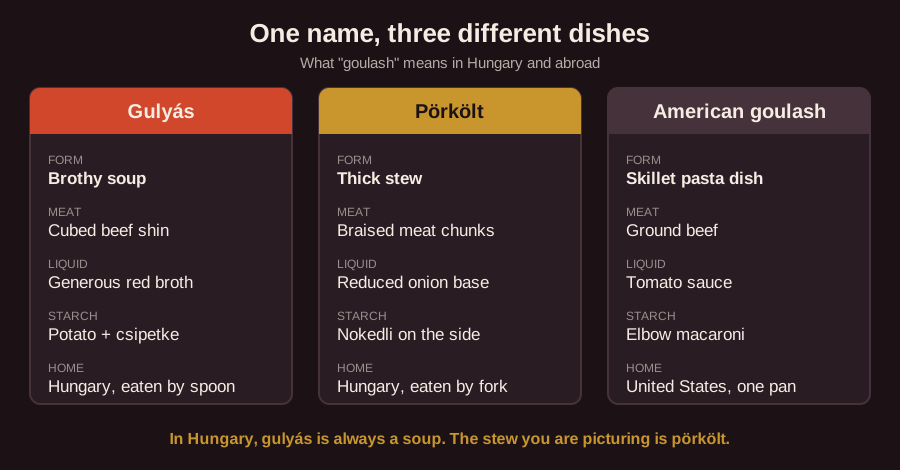
Within Hungary the variations stay proudly soup-shaped. Bográcsgulyás (kettle goulash) is the open-fire original. Babgulyás swaps some potato for beans and leans smokier. Palócleves, a close cousin, adds green beans and sour cream. Different accents, same language.
What Is The Difference Between Gulyás, Pörkölt, And Paprikás?
Gulyás is a soup. Pörkölt is the thick paprika stew: meat braised down in an onion and paprika base, served with nokedli dumplings. Paprikás is pörkölt finished with sour cream, classically made with chicken. Order all three across a few days and you have covered Hungary's paprika canon.
This trio confuses visitors more than anything else on a Hungarian menu, partly because pörkölt is exactly the dish foreigners expect when they say "goulash." The distinctions are simple once you see them side by side.
| Gulyás | Pörkölt | Paprikás | |
|---|---|---|---|
| Consistency | Brothy soup | Thick, reduced stew | Thick stew, creamy sauce |
| Typical meat | Beef | Beef, pork, or venison | Chicken, sometimes veal |
| Sour cream | Never in the pot | No | Yes, stirred in at the end |
| Served with | Bread, csipetke in the bowl | Nokedli or bread | Nokedli, always |
| Eat it with | Spoon | Fork | Fork |
My honest advice: have gulyás at lunch on your first day, then pörkölt or chicken paprikás at dinner later in the trip, so you taste the soup and the stew as separate ideas rather than blurred together. My rundown of what to eat in Budapest slots all three into a wider eating plan.
How Much Does Goulash Cost In Budapest, And Where Should You Taste It?
A bowl of gulyás in a Budapest restaurant currently runs about €6 to €10, roughly 2,400 to 4,000 forints, with simple étkezde lunch canteens at the low end and tourist-district terraces above it. Skip the laminated-menu strip on Váci utca and eat where the menu reads Hungarian first.
That €6 to €10 range holds across most of the city right now, a spread local food writers at Offbeat Budapest track bowl by bowl. Price signals little here; some of the worst gulyás of my life cost the most. Language on the menu is the better tell.
A few words rescue any menu encounter:
| On the menu | What it means |
|---|---|
| Gulyásleves | Goulash soup, the real thing |
| Bográcsgulyás | Kettle goulash, open-fire style, often richer |
| Babgulyás | Bean goulash, smokier and heavier |
| Hamis gulyásleves | "Mock" goulash, the thrifty meat-light version |
| Marhapörkölt | Beef pörkölt: the stew, not the soup |
For an independent bowl, compare the menu and serving style at the market counters and neighbourhood kitchens. If one bowl turns into a mission, the goulash crawl maps a longer route across the city.
How Can You Tell A Proper Bowl Of Gulyás From A Tourist Bowl?
Look at the surface before you taste anything. A proper bowl arrives loose and glossy, brick red rather than orange, with cubes of beef, potato and carrot visible in the broth. Thickness that mounds in the bowl, a sour cream swirl on top, or ground meat means you were served something else.
I have hosted more than a thousand visitors by my own count, and this is the judgment I am asked for most often, usually across a table with the bowl already steaming between us. Colour comes first. Sweet Hungarian paprika bloomed in warm fat gives that deep brick red with a fat sheen riding on the surface. An orange, slightly cloudy broth normally means tomato is doing work that paprika should be doing. A dull brown one means the paprika hit fat that was still hot, and burnt paprika turns the whole pot faintly bitter.
Then the meat. Shin or chuck given its two hours produces cubes that fall apart under the side of a spoon while still holding their shape. Lean, uniform dice that stay tight tell you someone rushed. Ground meat is not gulyás under any reading.
The third tell arrives alongside the bowl. Plain white bread is correct and sufficient. Nokedli dumplings on the side mean the kitchen has handed you pörkölt wearing a soup's name, which is not fraud, just a translation the menu never made. Sour cream spooned on top is decoration aimed at foreign guests.
None of this requires a Hungarian palate. It is all visible in the first ten seconds, before the spoon goes in.
| At the table | What a proper bowl looks like | What should worry you |
|---|---|---|
| Colour | Deep brick red, fat sheen on top | Orange and tomatoey, or dull brown |
| Consistency | Loose, needs a spoon | Mounds in the bowl, coats the spoon |
| Meat | Cubes of shin that break under a spoon | Ground meat, or tight lean dice |
| In the bowl | Potato, carrot, csipetke | Pasta shapes, heaps of bell pepper |
| Alongside | Plain white bread | Nokedli dumplings, sour cream swirl on top |
| First taste | Sweet paprika warmth, long beef finish | A bitter edge from scorched paprika |
What Comes With Gulyás At A Hungarian Table?
Bread, and a small arsenal within arm's reach. White bread in a basket, csipetke already floating in the broth, and on the table a jar of Erős Pista hot pepper paste, often its sweeter paprika cream sibling, plus salt. Sour cream stays in the kitchen, because that belongs to paprikás.
Hungarian lunch traditionally opens with soup, and gulyás is the one soup that cancels the rest of the meal. So the setting is deliberately bare. No starter, no side dish, no sauce boat. Bread and a spoon, and everything else is adjustment you make yourself.
Heat is the first adjustment. Classic gulyás is built on sweet paprika, so the kitchen sends it out mild on purpose and the fire lives in the jar. A matchhead of Erős Pista stirred in, taste, then a little more if you meant it. The sweet paprika cream is usually treated differently: Hungarians spread it on the bread rather than stirring it into the bowl.
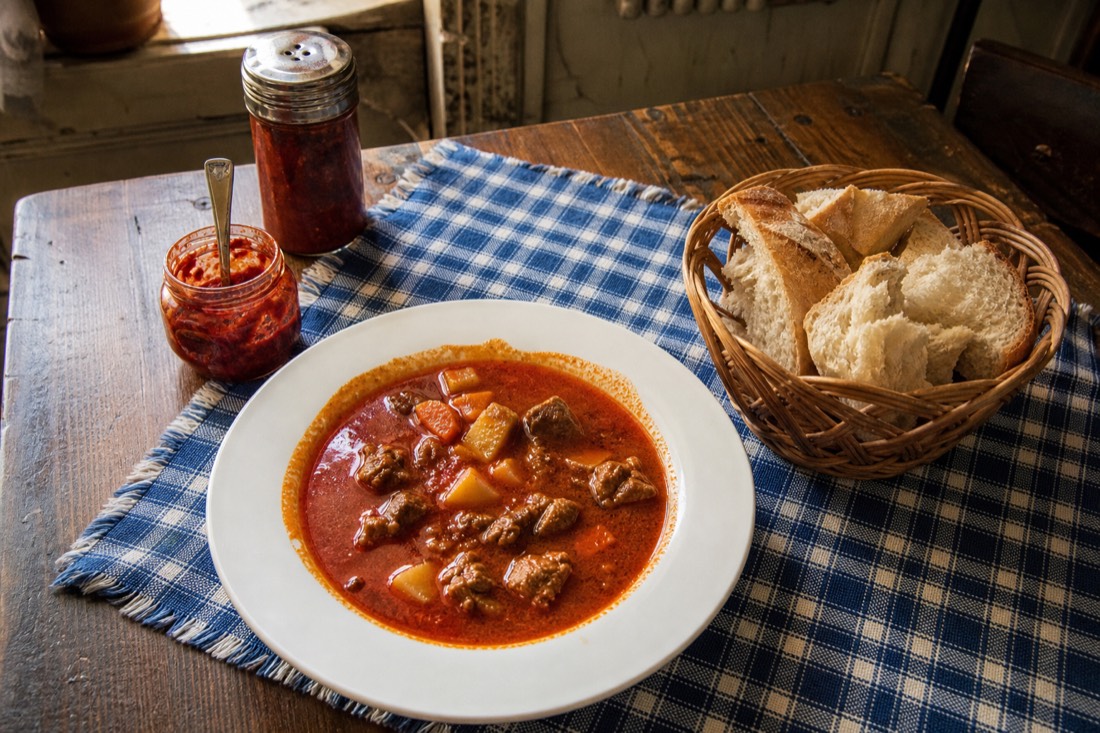
Bread gets torn, not dipped whole, and the last piece wipes the bowl. That is not bad manners here, it is the compliment. Eat it hot and unhurried, because a gulyás that cools loses the aroma that made it worth two hours. One more piece of table logistics: in the plainest lunch canteens the bread and the table extras may appear on the bill without being ordered, which is normal rather than a scam. My notes on tipping and the service charge explain how the rest of the bill works.
| On the table | What it is | What Hungarians do with it |
|---|---|---|
| Fehér kenyér | Plain white bread | Torn by hand; the last piece wipes the bowl |
| Erős Pista | Coarse hot pepper paste | Stir in a little, taste, then decide again |
| Paprika cream | Sweeter, milder pepper paste | Spread on bread rather than added to the soup |
| Csipetke | Pinched noodles cooked in the broth | Eaten as they come, never a separate order |
| Tejföl (sour cream) | Belongs to paprikás | Not added to a gulyás bowl |
Should You Order Gulyás, Pörkölt, Paprikás, Or Tokány?
Choose by what you want in front of you. Broth and a spoon means gulyás. A fork and a thick red sauce means pörkölt. That same stew softened with sour cream is paprikás. Tokány is the quiet cousin: meat cut into strips, black pepper and marjoram forward, paprika in a supporting part.
Think of it as a ladder rather than four unrelated dishes, because the bottom three are the same cooking idea at different levels of reduction. Gulyás keeps the liquid. Pörkölt boils it away until the onion and paprika base clings to the meat. Paprikás takes that stew and rounds it with sour cream, which is why chicken suits it and beef rarely does. Tokány steps sideways: the meat goes in as strips rather than cubes and the seasoning shifts toward pepper and marjoram, so it tastes less overtly red than the rest of the family.
The menu words that carry the answer are the meat prefixes. Marha is beef, sertés pork, csirke chicken, borjú veal. Put those in front of the dish name and you can order anything in the country: marhagulyás, sertéspörkölt, csirkepaprikás.
That vocabulary also solves most dietary questions. If you avoid pork, the beef dishes are the obvious route, though the traditional fat in any of these pots is lard, so ask what the base is built on rather than assuming. If you want it milder, you already have it: nothing classic arrives hot, and you simply leave the jar alone. If gluten is the issue, note that csipetke and nokedli are both flour and egg, so ask for the soup without csipetke; my gluten-free Budapest guide has the phrasing to use at the table.
| If you want | Order | What lands in front of you |
|---|---|---|
| One bowl that is the whole lunch | Gulyásleves | Red broth, beef, potato, carrot, csipetke, bread |
| The thick stew you pictured | Marhapörkölt | Beef braised in onion and paprika, nokedli alongside |
| Something creamy and gentle | Csirkepaprikás | Chicken in a sour cream paprika sauce, nokedli always |
| Meat without paprika dominating | Tokány | Strips of meat, pepper and marjoram, a darker sauce |
| No pork on the plate | Marhagulyás or marhapörkölt | Beef dishes; ask what fat the pot is built on |
| More heat than the kitchen gives | Any of the above, plus Erős Pista | The jar on the table, adjusted by you |
Does Gulyás From A Bogrács Taste Different From A Restaurant Pot?
Yes, and the difference is real rather than romantic. A kettle hung over wood cooks wide and open, so the broth concentrates while smoke works its way in, and the pot gets stirred by hand for hours. A covered restaurant pot on a gas ring gives a cleaner, steadier, slightly tamer bowl.
Geometry explains most of it. The bogrács is a wide iron belly with a huge open surface, so liquid leaves faster and the flavour tightens as the afternoon goes. Wood heat is uneven, which means the layer against the metal caramelises a little, and that faint scorch is half of what people mean when they say kettle goulash tastes deeper. The rest is smoke, which finds its way into anything cooked over a live fire for that long.
The other half is not chemistry at all. A bogrács holds enough for twenty people, so it is cooked for a crowd that has already arrived, and nobody hurries a pot they are standing around. Restaurant gulyás is made in advance, portioned, and reheated to order, which is why it is consistent and why many Hungarians insist, correctly in my view, that the second day is better than the first.
In the city, look for the word bográcsgulyás if you want a kettle-style version. A home-kitchen cooking class is a different experience and does not establish that you will cook over an outdoor cauldron.
Is Hungarian goulash spicy?
Barely. Classic gulyás is made with sweet paprika and lands warm, not hot. Heat arrives at the table instead: most places offer Erős Pista, a coarse hot pepper paste, so each eater sets their own fire. Ask for it and you will get an approving nod.
What is csipetke?
Small pinched noodles made from a stiff flour-and-egg dough, torn off in fingernail-sized pieces straight into the simmering soup. The name comes from csipet, a pinch. They cook in minutes and give gulyás its characteristic bite between spoonfuls of broth.
Can vegetarians order goulash in Budapest?
The classic is beef-based and the broth is meaty by definition, but many modern Budapest kitchens run a mushroom or bean version of the flavor idea. Look for vegán gulyás on menus, and treat it as its own dish rather than a substitute.
Choose Your Budapest Experience
Goulash Cooking At Chefparade. Make goulash soup, a paprika main and apple strudel in a hands-on three-course cooking class. Have a date in mind? Check it before arranging the rest of your Budapest day.
180 minutes. Age 6+. Studio address is confirmed as Páva utca 13 or Bécsi út 27. Vegetarian menu on request; confirm the menu and dietary requirements before booking.
Choose a date to see scheduled departures. Final availability and price are confirmed on Viator.
No verified experience fits those requirements. Adjust your choices, or keep the independent plan described above.
Compare Options And Fit Your Plans
General recommendations until you choose. Sightseeing cruises use recorded commentary; the dinner cruise has no guide. All selected activities meet in central Pest; use the operator confirmation for the exact point and option.
- Foodapest Market To Tavern: 180 minutes. Traditional dishes, street-food tasters and wines with an English-speaking local guide. Daytime option visits the market; the 17:00 option skips it. Notify the operator about vegetarian or vegan substitutions. Not suitable for coeliac requirements.