What to eat at Budapest's Christmas markets (2026-2027 season)
What to eat at Budapest's Christmas markets, chimney cake, flódni and mulled wine at Vörösmarty and the Basilica, with 2025 dates, prices and awards.
 By Gábor Kovács, Budapest local specialist and experience guide
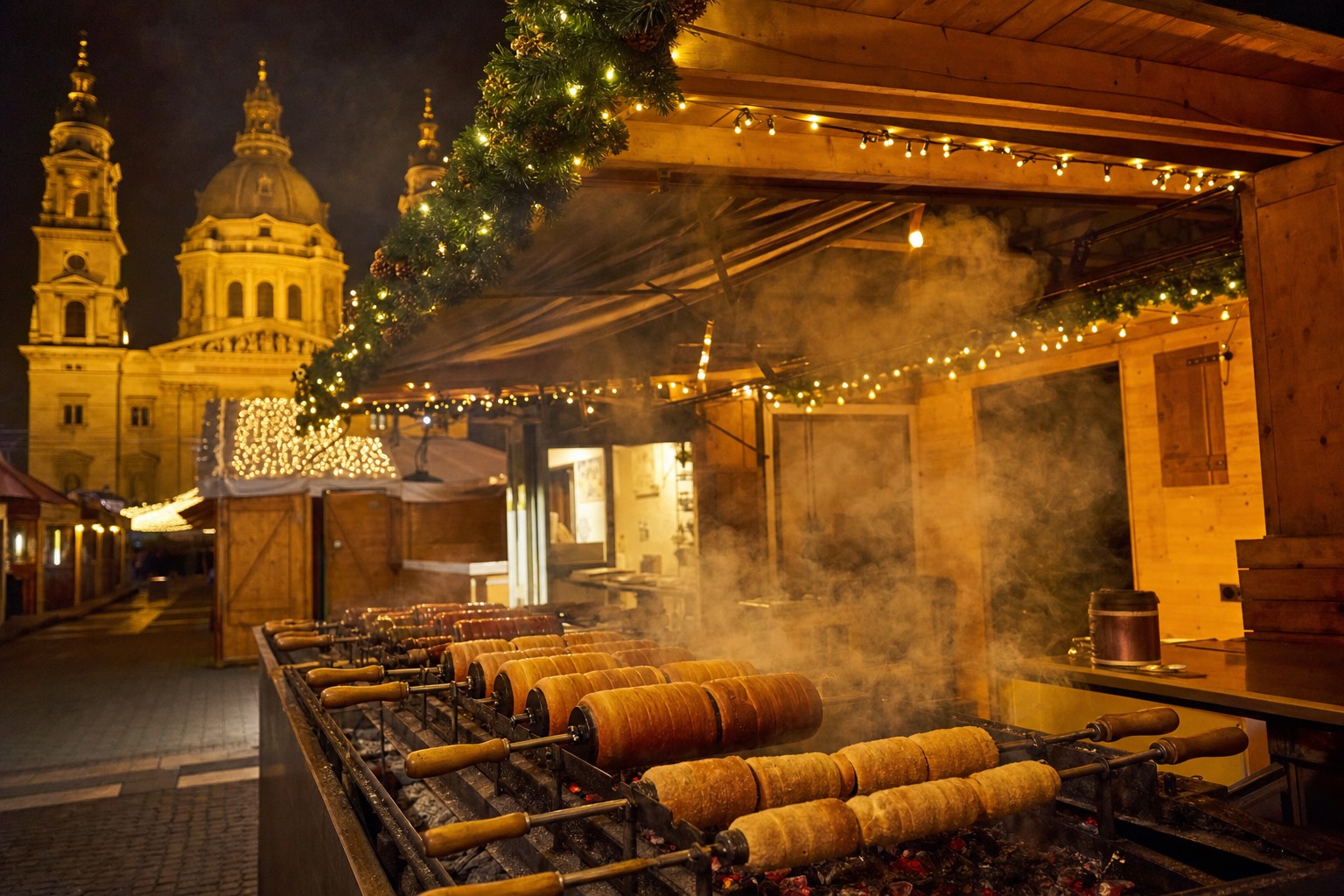
I am writing this in July with the windows open and the fan on, which is absurd, because the smell I am describing is December: caramelized sugar and cinnamon rolling off a chimney cake spit into air cold enough to bite. Every winter of my life has included at least one evening eaten standing up between Vörösmarty Square and the Basilica. Here is how to do that evening properly, and an honest word about what happens if you visit in any other season.
Use the market comparisons below to plan your own evening. For a guided visit, choose an actual seasonal Christmas-market route.
Booking choice: Explore Christmas markets with a local guide, a Basilica visit, chimney cake and a warming drink. Explore Christmas Markets With Chimney Cake
Which Market Is Better For Food, Vörösmarty Or The Basilica?
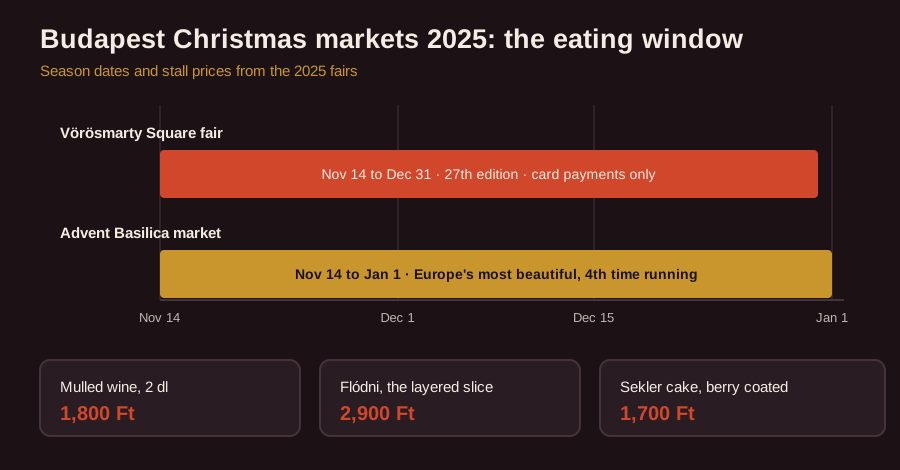
Both, and they are a ten-minute walk apart. Vörösmarty Square is the older institution, its 2025 fair the 27th edition. The Advent Basilica market at St. Stephen's has been voted Europe's most beautiful Christmas market four times running. Eat at one, cross to the other for dessert.
The two markets have settled into roles. Vörösmarty is the food-first veteran, stalls packed tight across the square where Gerbeaud's windows glow behind them. The Basilica market is the looker, and not just by my judgment: the official Advent Bazilika site carries the fourth consecutive "Europe's most beautiful" title it took ahead of the 2025 season, with the light show projected onto the church façade as its closing argument. My routine has not changed in years: savory food at Vörösmarty, then the walk up Zrínyi utca with a warm cup, then dessert under the Basilica lights.
| Market | 2025-26 dates | Claim to fame | Payment |
|---|---|---|---|
| Vörösmarty Square fair | Nov 14 to Dec 31, 2025 | 27th edition, the food veteran | Bank card or credit card only |
| Advent Basilica | Nov 14, 2025 to Jan 1, 2026 | Europe's most beautiful, 4 times running | Plan for card payments here too |
When Do The Markets Actually Run?
In 2025 the Vörösmarty Square fair ran from November 14 to December 31, and the Advent Basilica market from November 14 through January 1, 2026. Expect similar windows each winter: mid-November opening, the Basilica running slightly longer into the new year.
Those dates come from the Budapest Christmas market calendar, and the pattern holds from year to year even as exact days shift. The useful planning detail is the tail: the Basilica market carries past New Year's Eve, so a first-week-of-January trip still catches it, barely. Crowds peak on the December weekends before Christmas. Locals go on weekday evenings in late November, when the stalls are all open, the queues are short and the chimney cake spits are not yet running flat out.
What Should You Eat First When You Arrive?
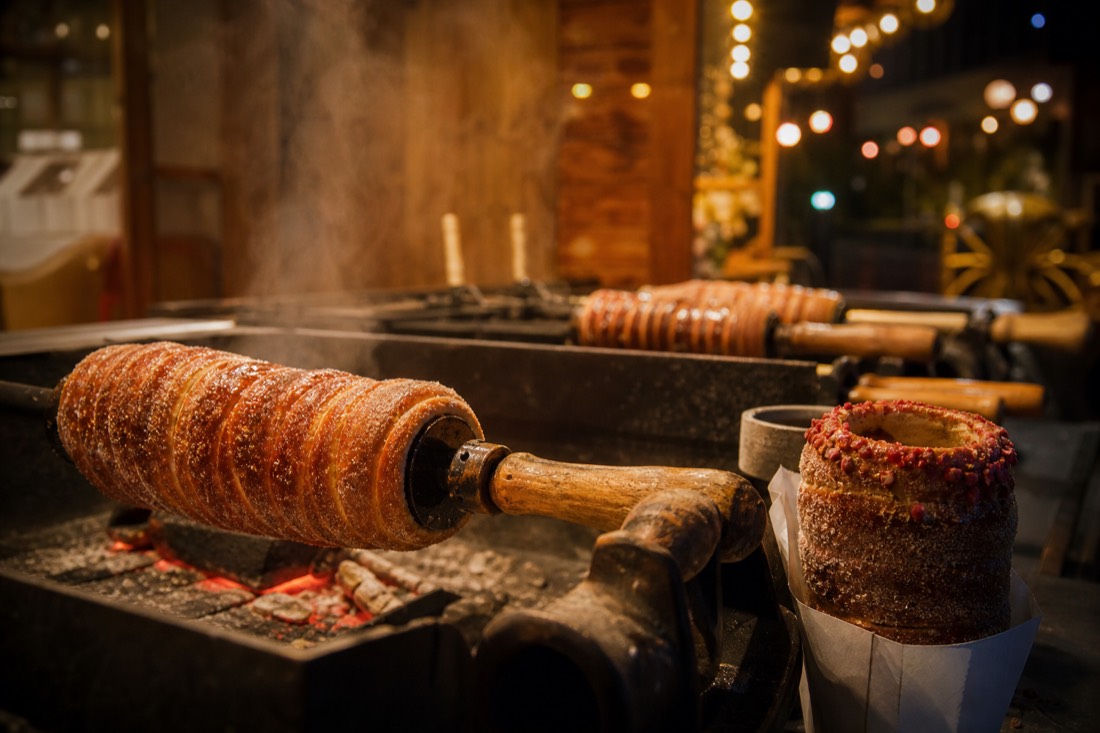
Kürtőskalács, the chimney cake. Watch the dough spiral turn over coals, then hold the hot cylinder while steam pours out of it into the cold air. At the 2025 Vörösmarty fair, the Vitéz Kürtös stall sold a version coated in dried raspberry and cranberry for 1,700 forints.
Kürtőskalács, for the unglossed, is sweet dough wound around a wooden spit, roasted until the sugar shell cracks, then rolled in walnut or cinnamon or, at Vitéz Kürtös, those dried berries. The steam is the whole show. On a cold night the hollow cylinder breathes like a chimney, which is where the name comes from, and eating it while it steams is a two-hand, no-gloves commitment. I have chased the city's best versions across every season, and that hunt has its own write-up in my chimney cake piece. The market version wins on atmosphere alone.
What Is Flódni And Why Do Locals Queue For It?
Flódni is Budapest's Jewish layered cake: apple, walnut, poppy seed and plum jam stacked between thin pastry. At the 2025 markets a slice cost 2,900 forints, which sounds steep until you realize it is four desserts in one and dense enough to share.
Flódni is the cake my family argues about most, because everyone's grandmother made one layer better than anyone else's. It comes out of the old Jewish quarter, District VII, and for most of the year you hunt it in a handful of bakeries. December puts it on the squares. A cold slice with hot wine is one of the city's great pairings, and it is the single market food I would defend at 2,900 forints without blinking. Split the chimney cake if you must economize. Do not split the flódni.
What Does Mulled Wine Cost, And Do You Need Cash?
A two-deciliter cup of forralt bor, mulled wine, cost 1,800 forints at the 2025 markets. And no, you do not need cash: Vörösmarty vendors accepted only bank or credit cards. Bring a card that does not charge foreign transaction fees and skip the airport exchange desks entirely.
Both figures come from local reporting on the fairs, and the card-only rule surprises people every single winter. I have watched visitors wave forint notes at a mulled wine stand and get pointed, kindly, at the card reader. Forralt bor itself is red wine warmed with cinnamon, clove and citrus, ladled steaming into cups that double as hand warmers. Pace yourself; the cups are small but the stalls are many.
| Market treat | 2025 price | The gloss |
|---|---|---|
| Forralt bor, 2 dl | 1,800 HUF | Hot spiced wine, the official market fuel |
| Sekler cake at Vitéz Kürtös | 1,700 HUF | Chimney cake coated in dried raspberry and cranberry |
| Flódni | 2,900 HUF | Four-layer Jewish cake: apple, walnut, poppy seed, plum |
What Savory Food Is Worth The Queue?
Head for the hot pans: töltött káposzta, cabbage leaves stuffed with pork and rice, slow-cooked sausages, and lángos fried to order. Portions are festival-sized, so split everything. My rule every season: one savory dish per square, shared, before anything sweet touches the gloves.
Töltött káposzta is winter itself in a bowl, sour cabbage mellowed by hours of cooking, and the market versions ladle sour cream on top with real generosity. Lángos, the fried dough slab that rules the city's snack culture year-round, gets a festive upgrade at some stalls. If you are cataloguing what Hungarian dishes to prioritize beyond the markets, the what to eat guide ranks them all, and the food price guide covers what the same dishes cost off the squares. One practical note from long experience: eat the savory course early. The sweet stalls stay tempting all evening, but stuffed cabbage eaten at ten pm sits like a verdict.
This is the order I feed visiting friends, every December, without deviation:
| Order | Dish | Sweet or savory | Why then |
|---|---|---|---|
| 1 | Töltött káposzta | Savory | A warm base before anything else |
| 2 | Sausage or lángos | Savory | Shared, while hands are still warm |
| 3 | Kürtőskalács | Sweet | Eaten hot off the spit, no waiting |
| 4 | Forralt bor | Drink | The hand-warmer for the walk between squares |
| 5 | Flódni | Sweet | The dense finale, half a slice each |
What If You Visit Budapest In Summer Instead?
The markets are a winter-only experience. Hungarian dishes and pastries remain available in other settings throughout the year; a regular food walk is not a Christmas-market tour.
The markets are a winter-only experience. Chimney cake bakeries and flódni shops operate beyond the Christmas season, and paprika is available throughout the year, as the paprika shopping guide explains.
How Do You Plan A Market Evening Without Freezing?
Go at dusk, when the lights come on and the crowds are still thin. Eat savory first, keep the mulled wine for the walk between squares, and wear gloves you can eat in. Two hours covers both markets with time to circle back for a second chimney cake.
Dusk in December falls around four, which means the full spectacle starts early and you can be home by eight, warm and victorious. Layer up more than you think necessary; you will be standing on stone squares, not walking. The wine cup between markets is strategic heating. And leave one hand glove-free or wear the thin kind, because kürtőskalács waits for no one and paper napkins only do so much. The first steaming bite under the Basilica lights is the argument for a winter trip. Everything else in this piece is just supporting evidence.
Choose Your Budapest Experience
Christmas Markets With Chimney Cake. Explore Christmas markets with a local guide, a Basilica visit, chimney cake and a warming drink. Have a date in mind? Check it before arranging the rest of your Budapest day.
150 minutes. Seasonal departures; confirm your actual holiday date. Meet at the Opera House entrance staircase. Additional food and purchases cost extra.
Choose a date to see scheduled departures. Final availability and price are confirmed on Viator.
No verified experience fits those requirements. Adjust your choices, or keep the independent plan described above.
Compare Options And Fit Your Plans
General recommendations until you choose. Sightseeing cruises use recorded commentary; the dinner cruise has no guide. All selected activities meet in central Pest; use the operator confirmation for the exact point and option.
- Downtown Chimney-Cake Workshop: 60 minutes. Shape, bake and season three chimney cakes, then take the recipe and your cakes home. Age 7+. Meet inside Kató Néni Finomságai, Október 6. utca 6. Basement workshop; not wheelchair accessible. Vegan dough; confirm toppings and any allergies.
- Foodapest Market To Tavern: 180 minutes. Traditional dishes, street-food tasters and wines with an English-speaking local guide. Daytime option visits the market; the 17:00 option skips it. Notify the operator about vegetarian or vegan substitutions. Not suitable for coeliac requirements.