Where Did Anthony Bourdain Eat in Budapest? Every Documented Stop
One episode, three tables, and a portrait of Budapest that still holds up. Here is exactly where Bourdain ate, what he ordered, and what remains of the trail.
 Written with Gábor Kovács, Budapest local specialist and experience guide
Short answer
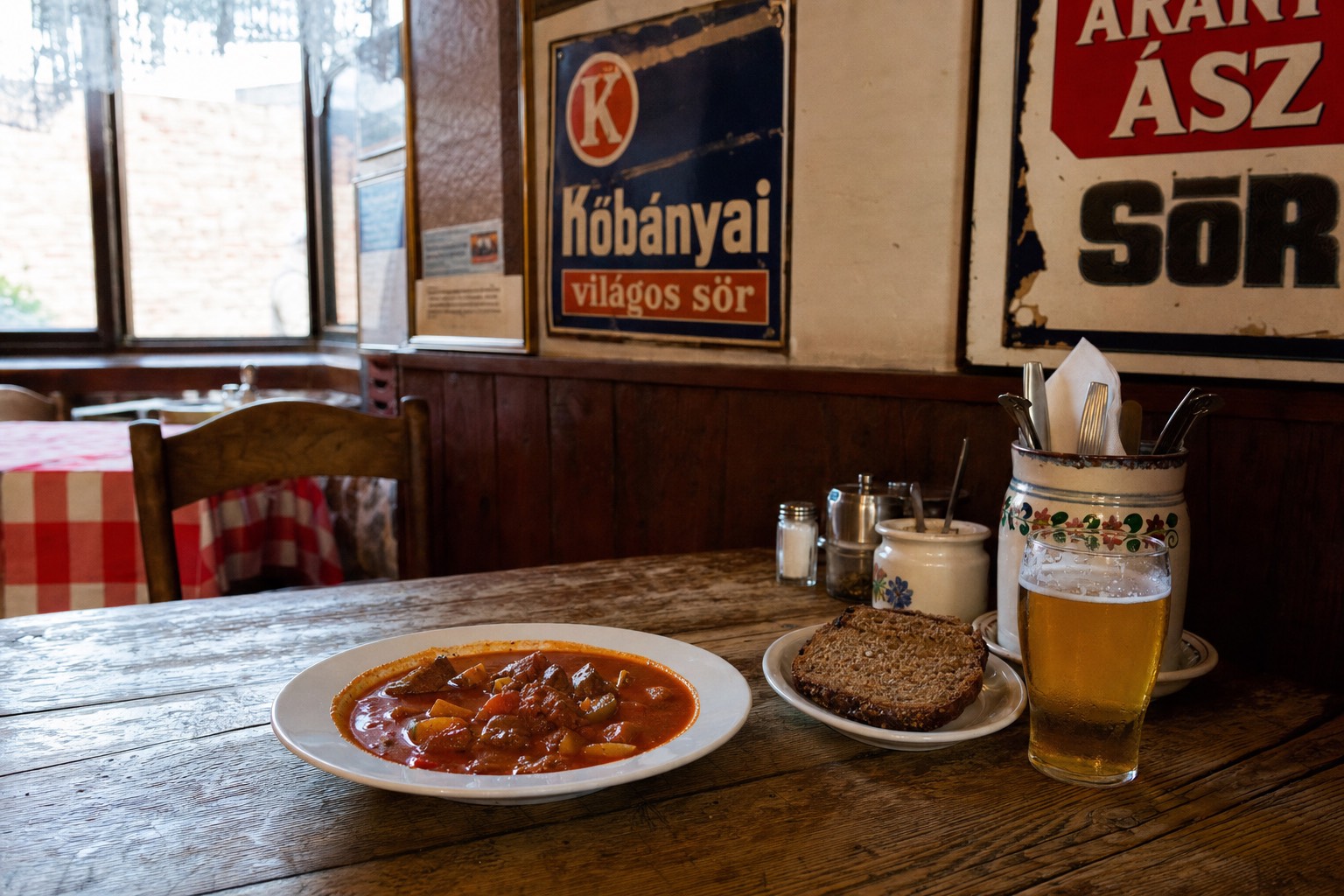
Anthony Bourdain filmed Parts Unknown Season 5, Episode 6 in Budapest, first aired June 7, 2015. His three documented food stops were New York Café (goose liver terrine, lamb ragout soup, perch, pork trotter stew), roadside tavern Pléhcsárda (chicken liver pancake, venison stew, schnitzel), and butcher counter Belvárosi Disznótoros (blood sausage with pickles and cabbage). All three trace back to the episode record.
Budapest got Anthony Bourdain at his best: curious, unhurried, more interested in a butcher's blood sausage than in anything with a Michelin plaque. I rewatched the episode before writing this, notebook out, and what struck me is how well his three stops still describe the city I live in. A gilded café, a roadside tavern, a stand-up butcher counter. That is Budapest's whole range in one shooting schedule. This guide follows the documented trail, dish by dish, with the current status of each venue.
Use the independent route below for the full television trail. The selected Foodapest walk lists Belvárosi Disznótoros, while the café-history alternative includes New York Café.
Booking choice: Taste lángos, chimney cake and seasonal Hungarian dishes on a guided food walk; gluten-free substitutions can be requested. Explore Foodapest Evening Food Walk
Where Did Anthony Bourdain Eat In Budapest?
At three documented venues, all filmed for Parts Unknown: New York Café, the grand 1894 coffee house; Pléhcsárda, a no-frills roadside tavern out in District XV; and Belvárosi Disznótoros, a downtown butcher shop and counter joint. Between them he covered aristocratic dining, old-school tavern cooking, and pure Hungarian street-level eating.
The choice of venues was classic Bourdain. Most food television shot in Budapest at the time went straight for goulash cauldrons and folklore shows. He went instead for contrast: the most opulent café in Europe followed by a tin-sided tavern locals drive to, followed by sausages eaten standing at a butcher's ledge. Fan researchers have kept the trail meticulously documented at Eat Like Bourdain, down to the plates on the table.
| Venue | The setting | Who joined him |
|---|---|---|
| New York Café | Gilded 1894 grand café, District VII | Writer Peter Zilahy |
| Pléhcsárda | Roadside tavern, Kolozsvár utca 48, District XV | Locals over tavern plates |
| Belvárosi Disznótoros | Butcher counter, Károlyi utca, District V | Butchery expert Daniel Maté |
For anyone building a Budapest eating list, that table is a better starting syllabus than most guidebooks. The rest of this article unpacks each stop.
Which Show And Episode Covered Budapest?
Parts Unknown, Season 5, Episode 6, first aired on June 7, 2015 on CNN. It was Bourdain's dedicated Budapest hour, shot around the city with local companions rather than celebrity guests, and it remains the definitive piece of American food television about the Hungarian capital.
The airdate matters more than trivia value: everything in this guide describes Budapest as he found it in 2015, and the city has kept moving since. Prices have climbed, menus have evolved, and one of his venues sits far enough off the tourist map that its current status takes actual checking, which I have done below. The episode record itself is logged at Rotten Tomatoes, and CNN's companion project Explore Parts Unknown published venue details that fans still lean on.
Watching it today is a strange, warm experience. He is missed, in this city as everywhere, and the episode holds up precisely because he refused to treat Budapest as a postcard. If you want the mood before your trip, watch it the week you fly.
What Did Bourdain Eat At New York Café?
A deliberately old-world spread: goose liver terrine, white lamb ragout soup, perch filet, and pork trotter stew, shared with Hungarian writer Peter Zilahy under the frescoes. The order read like a menu from the café's 1900s literary heyday, which was exactly the point of the scene.
The New York Café segment was about history as much as food. The café opened in 1894 and spent its golden decades as the headquarters of Hungarian letters, so putting a working writer across the table was the right casting. The dishes leaned aristocratic Hungarian: foie gras done as terrine, a paprika-less white ragout soup that surprises people who think Hungarian cooking is all red, river fish, and trotters cooked with peasant patience in a palace room.
Two practical notes for anyone retracing the scene. First, the café still operates, and its official site confirms it is very much alive, though the menu has evolved since 2015, so do not expect his exact plates. Second, the queue and pricing situation deserves its own briefing, which is exactly what my New York Café guide covers, including when to go and what the service charge does to the bill.
What Did He Order At Pléhcsárda?
The tavern trifecta: a pancake covered with chicken liver in bone marrow paprika sauce, venison stew, and a large pork schnitzel with potato chips, washed down with beer. Pléhcsárda, at Kolozsvár utca 48 in District XV, is exactly the kind of unfancy local institution he built his career championing.
A csárda (a traditional Hungarian roadside tavern) is where Hungarian comfort food lives without adjustment for visitors, and Pléhcsárda's name literally nods to its tin-shack character. The chicken liver pancake in bone marrow paprika sauce is the dish fans remember from the scene: offal, thickened paprika sauce, and a savory Hungarian palacsinta (crepe-style pancake) in one plate, documented in CNN's own Explore Parts Unknown notes.
This is the stop that takes commitment. District XV sits well outside the tourist core, the menu works best with some Hungarian or some pointing, and portions assume you have been doing manual labor. It is also the stop that teaches you the most. The paprika cookery on that table connects straight to the traditions in my goulash guide, and once you have eaten stew in a proper tavern, restaurant versions downtown make sense as the polished descendants they are.
What Happened At Belvárosi Disznótoros?
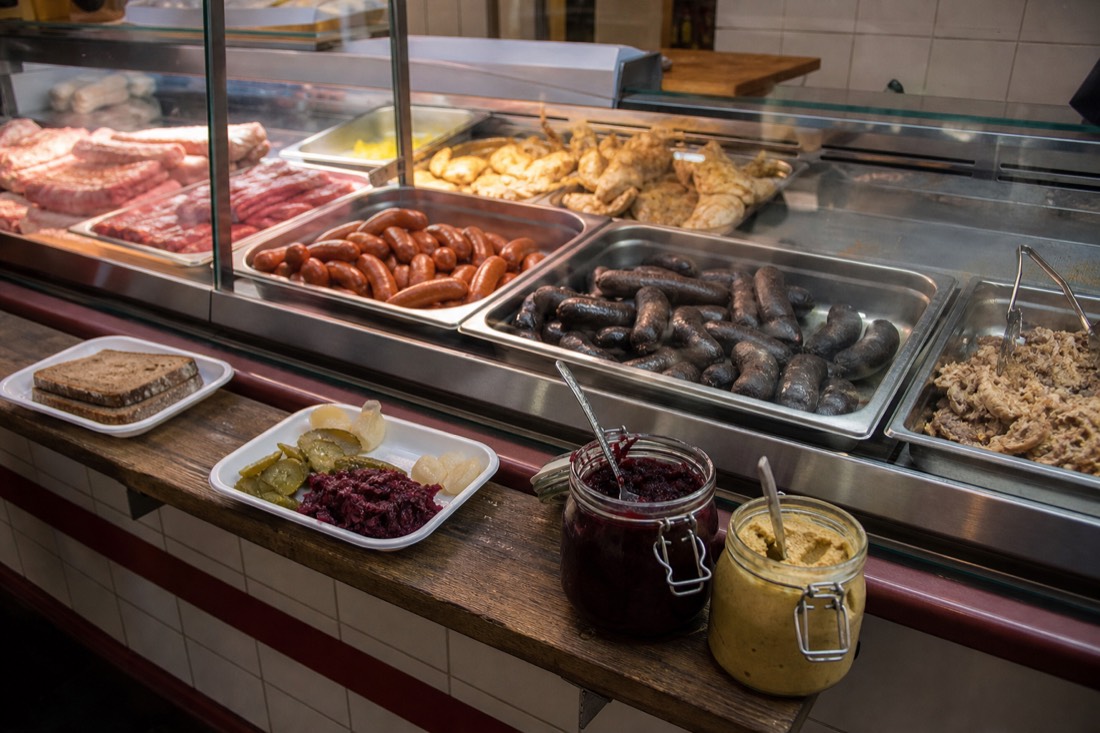
Bourdain stood at the counter of this downtown butcher shop with butchery expert Daniel Maté and ate blood sausage with pickles, braised red cabbage, and mustard. A disznótoros is a pig-slaughter feast, and this shop serves that tradition daily over a glass ledge, no seats, no ceremony.
Of the three stops, this is the one I would defend hardest as essential Budapest. Disznótoros (the traditional feast held after a family pig slaughter, and by extension the sausages and cuts that come from it) is Hungarian food at its most direct. You queue, you point, someone weighs sausages onto a paper plate, mustard and bread and pickles appear, and you eat standing up among office workers who have been ordering the same thing for years.
The scene worked because Bourdain respected the counter for what it was. No attempt to elevate it, no irony about the blood sausage. He treated hurka and kolbász (Hungary's liver-and-rice sausage and its paprika pork sausage) as the serious food they are. If your Budapest eating has so far been ruin-bar hot dogs and café cake, this counter is the corrective, and it slots naturally into the bigger picture in my Hungarian food guide.
Are Bourdain's Budapest Venues Still Open?
Two of three are confirmed operating. Belvárosi Disznótoros remains open in 2026 at its Károlyi utca location, running roughly 11 am to 6 pm on weekdays, closed Sundays, with a second site. New York Café is fully active. Pléhcsárda's current status is not something I can vouch for, so call before making the District XV trip.
Here is the status board, kept honest:
| Venue | Status on record | Practical note |
|---|---|---|
| New York Café | Open, official site active in 2026 | Menu has evolved since the 2015 filming; expect queues |
| Belvárosi Disznótoros | Open in 2026, Károlyi utca plus a second site | Weekday daytime hours, closed Sundays; go at lunch |
| Pléhcsárda | No current confirmation on my file | Verify by phone before traveling out to District XV |
That Pléhcsárda caveat is deliberate. It sits far from the center, and a pilgrimage to a closed tavern is a sad afternoon. The two confirmed stops, conveniently, are both central: you can queue for the café in the morning and hit the butcher counter for a late lunch, with the Great Market Hall a short walk from the latter if you want to keep the momentum going.
How Do You Retrace Bourdain's Budapest Today?
Build the independent trail around the central stops and check each venue’s current hours. A separate food walk can add Hungarian dishes and local context, but the verified products here do not promise Bourdain’s route or venues.
My suggested running order, having eaten every element of it as a local:
| Time | Stop | What you are recreating |
|---|---|---|
| 9:00 | New York Café at opening | His terrine-and-trotters scene, minus the crowd |
| 11:30 | Walk to District V | Digest along the Danube like a sensible person |
| 12:30 | Belvárosi Disznótoros | Blood sausage at the counter, weekday lunch |
| 15:00 | Great Market Hall | The raw ingredients behind everything he ate |
| Evening | District VII tastings | The tavern spirit, delivered walking distance from your hotel |
How Much Time Does Each Stop On The Trail Need?
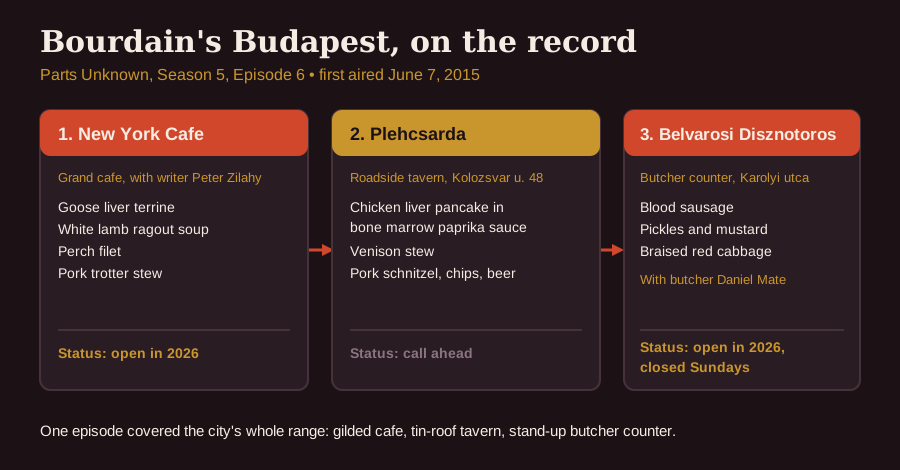
Allow about two hours for the café including the queue, about forty minutes for the butcher counter, and a half day if you add Pléhcsárda out in District XV. The two confirmed central stops fit comfortably into one weekday, provided that weekday is not a Sunday.
The constraint that shapes everything is the butcher counter's schedule. Belvárosi Disznótoros keeps weekday daytime hours on Károlyi utca, roughly 11 am to 6 pm, and closes on Sundays, so the trail has to be built around a working lunchtime rather than an evening. Anyone planning this for a weekend should check the day carefully first, because a Sunday attempt leaves you with a café and a locked door.
New York Café is the opposite kind of constraint. It never closes on you, but it charges you time instead: daytime seating is first-come, first-served, and peak waits run 30 to 50 minutes. Arriving at the 7 am opening is what turns the café from a two-hour commitment into a one-hour one, and it happens to be the version of the room Bourdain filmed, quiet and mostly empty.
Pléhcsárda is the honest unknown. It sits at Kolozsvár utca 48 in District XV, well outside the tourist core, and its current status is not something I can confirm. Treat it as a separate expedition with a phone call in front of it, not as a stop you tack onto a walking day.
| Stop | Allow at the venue | The constraint that sets the time |
|---|---|---|
| New York Café at the 7 am opening | About one hour | Little or no queue in the first hour, plus formal table service |
| New York Café at a peak hour | About two hours | The 30 to 50 minute wait sits in front of everything else |
| Belvárosi Disznótoros | About forty minutes | Counter service, standing room, weekday daytime hours only |
| Walking between the two central stops | Budget roughly thirty minutes | Both sit in the central districts, so this is a walk, not a journey |
| Great Market Hall as the context stop | Allow about an hour | Big building, and the upstairs food level takes longer than people plan for |
| Pléhcsárda, if you go | Half a day, realistically | District XV is a trip out, and the status needs confirming by phone |
What Should You Order At Each Stop, And Why Did He Order It?
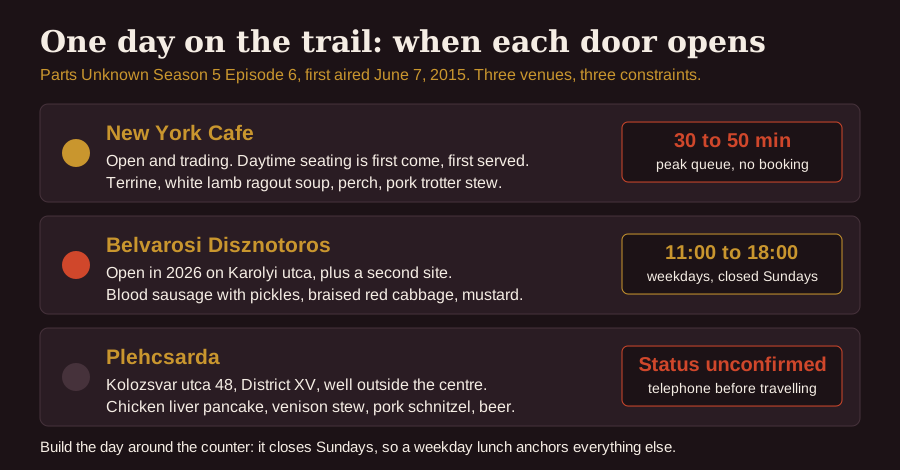
Order what the record shows, and understand the logic behind it. Each of his three menus was chosen to say something different about Hungarian eating: aristocratic dining at the café, unadjusted tavern cooking at the csárda, and the butcher's tradition standing up at the counter.
The café order was a period piece. Goose liver terrine, white lamb ragout soup, perch filet and pork trotter stew read like a menu from the room's literary heyday, and the white ragout was doing quiet work: it tells anyone who thinks Hungarian food is uniformly red-with-paprika that the country's older repertoire says otherwise. The trotters make the same point from the other end, peasant patience served under a frescoed ceiling.
At Pléhcsárda the point was the absence of adjustment. A pancake covered with chicken liver in bone marrow paprika sauce is not a dish anyone invents for visitors, and the venison stew and the schnitzel with potato chips are what a tavern feeds people who drove out to eat. The paprika technique on that table is the same one running through my goulash guide, which is worth reading before you order any Hungarian stew anywhere.
The counter order was the thesis of the whole episode. Blood sausage with pickles, braised red cabbage and mustard, eaten standing, with a butchery expert explaining it. Nothing elevated, nothing ironic. If you only replicate one plate from this trail, replicate that one, and treat the pickles and cabbage as part of the dish rather than a garnish.
| Venue | What he ate on camera | What the choice was saying |
|---|---|---|
| New York Café | Goose liver terrine, white lamb ragout soup, perch filet, pork trotter stew | The café's 1900s repertoire, and that Hungarian cooking is not only paprika red |
| Pléhcsárda | Chicken liver pancake in bone marrow paprika sauce, venison stew, large pork schnitzel with potato chips and beer | Tavern food cooked with no adjustment for outsiders |
| Belvárosi Disznótoros | Blood sausage with pickles, braised red cabbage, mustard | The butcher's tradition taken seriously, eaten the way locals eat it |
What Should You Check Before You Walk The Trail?
Three things, in this order: the day of the week, the butcher counter's hours, and whether Pléhcsárda is trading. The episode aired in June 2015, so a decade of menu changes sits between the footage and your lunch. Nothing on the trail is frozen for your benefit.
Start with the calendar, because it eliminates the most trips. Belvárosi Disznótoros closes on Sundays and works daytime hours, which means a Sunday plan is not a plan and an evening plan is not either. A weekday around midday is the version that works, and it also puts you at the counter alongside the office workers who keep the place honest.
Then the menus. New York Café is fully open and its official site is active, but the menu has moved on since filming, so do not travel expecting his exact four dishes to be printed and waiting. Read what is there now and order in the same spirit instead: the oldest-sounding thing on the list rather than the most photogenic. The café's queue and pricing situation gets its own briefing in the New York Café guide, and it is worth reading before you commit a morning to it.
Finally, the tavern. Pléhcsárda has no current confirmation on my file, and District XV is a genuine trip out of the centre, so a phone call before you travel is the difference between a good story and a wasted afternoon. If the answer is no, or if the call is beyond your Hungarian, the tavern register is available closer to home through the guided off-path evening described further up this page.
| Before you go, check | Why it matters | How to do it |
|---|---|---|
| The day of the week | The butcher counter closes Sundays and keeps daytime hours | Pick a weekday and plan the counter for lunchtime |
| Current menus | A decade of changes since the 2015 filming | Read the current list and order in the same spirit, not the same words |
| The café queue at your hour | Peak waits of 30 to 50 minutes reshape a morning | Aim for the 7 am opening, or book the evening sitting instead |
| Whether Pléhcsárda is trading | No current confirmation on file | Telephone before travelling out to District XV |
| Your appetite for the day | Three heavy stops in one day defeats most people | Choose two stops and eat them properly |
| Cash or card at counter stops | Counter joints and market stalls vary anywhere | Carry some forint so a queue never becomes a problem |
What Does His Approach Teach About Eating In Budapest?
That range beats ranking. He put the most opulent café in Europe, a tin-sided roadside tavern and a stand-up butcher counter in one hour of television, and the argument was that you need all three to understand the city. No single restaurant in Budapest can tell you what this place eats.
Gábor Kovács, who has guided visitors here since 2022 and, by his own count, has hosted over a thousand of them, uses the same shape when someone asks him to plan a first trip. One grand room for the history, one unpolished local kitchen for the cooking, one counter or market for the ingredients. It is not a Bourdain tribute. It is simply the only structure that covers a food culture built on peasant technique and imperial ceremony at the same time.
The second lesson is about deference, and it is easy to state and hard to practise. He did not turn the blood sausage into a dare, and he did not treat the trotters as a curiosity. The food was allowed to be ordinary, which is the highest compliment a visitor can pay a national cuisine. Visitors who arrive determined to be adventurous usually eat worse than visitors who arrive determined to be attentive.
The third is scheduling, and it is unglamorous. He ate at places that were open when he arrived, with people who knew what they were talking about, and he ordered what the room was good at. Copy that and you will eat well in Budapest without a single reservation. For the wider map of what to order once you are here, my Hungarian food guide covers the canon he was sampling from.
Who Will Enjoy This Trail, And Who Will Not?
Anyone who likes eating as a way of reading a city will love it, and it works particularly well for solo travellers and pairs. Anyone chasing a checklist, travelling with fussy eaters, or hoping to sit down to comfortable meals three times will find it hard work.
Be honest about the offal question first. Blood sausage, chicken liver in a bone marrow sauce and goose liver terrine are the spine of this trail, not optional extras, and a traveller who dislikes all three is left with a schnitzel and a slice of cake. There is no shame in that, but it means the trail is the wrong plan and a broader eating day is the right one. The what to eat in Budapest guide offers a friendlier route through the same city.
It also asks for a certain tolerance of discomfort. You will queue at the café, stand at the counter, and possibly travel to District XV for a tavern that may not be there. Nothing about this is smooth, and the people who enjoy it most are the ones who find the roughness interesting rather than annoying. Families with small children in particular should think twice about the queue and the standing.
Who gets the most from it, in my experience, is the traveller with three or four days and a real appetite, who wants one day of their trip to be about something other than sightseeing. Do the café at opening, the counter at lunch, the market in the afternoon, and finish with an off-path evening. That is a full day of genuine Budapest eating, and it costs less than one dinner in most European capitals.
Did Bourdain eat goulash on the Budapest episode?
Goulash was not the centerpiece of his documented plates; his stew moments came as pork trotter stew at New York Café and venison stew at Pléhcsárda. The paprika-stew tradition behind all of it is the same family, which my goulash guide traces from cauldron to restaurant bowl.
Is the Bourdain trail doable in one day?
The two confirmed central stops, yes, comfortably: New York Café at morning opening and Belvárosi Disznótoros for a weekday lunch, remembering it closes Sundays. Adding Pléhcsárda means a trip out to District XV and a status check by phone first.
Which single Bourdain stop is most worth it?
Belvárosi Disznótoros, for the money and the honesty. It is central, cheap, confirmed open, and serves the butcher-counter tradition he loved exactly as locals eat it. The café is grander, but the counter is the meal you will still be talking about at home.
Choose Your Budapest Experience
Foodapest Evening Food Walk. Taste lángos, chimney cake and seasonal Hungarian dishes on a guided food walk; gluten-free substitutions can be requested. Have a date in mind? Check it before arranging the rest of your Budapest day.
180 minutes. Evening option meets at Mercure Korona and skips the market. Some tastings may be substituted or skipped. Gluten-free options do not make this suitable for coeliac disease: the operator cannot guarantee against cross-contact.
Choose a date to see scheduled departures. Final availability and price are confirmed on Viator.
No verified experience fits those requirements. Adjust your choices, or keep the independent plan described above.
Compare Options And Fit Your Plans
General recommendations until you choose. Sightseeing cruises use recorded commentary; the dinner cruise has no guide. All selected activities meet in central Pest; use the operator confirmation for the exact point and option.
- Private Café History Walk: 180 minutes. Explore grand coffeehouses with an art historian, including New York Café in the documented route. Meet outside Gerbeaud at Vörösmarty tér 7–8. Refreshments and tips cost extra. This is a guided café-history walk, not a New York Café table reservation or queue-skip ticket.
- Withlocals Private Food Tastings: 180 minutes. Explore Budapest with your own foodie host, with six or ten tastings and vegetarian alternatives on request. Allow 180 minutes for ten tastings; the six-tasting option is 120 minutes. Meet outside the Great Market Hall. No hotel pickup. Tell the host your dietary needs; vegan and coeliac suitability are not established.